Why Decolonization Is Woven Into Our Regenerative Leadership Journey

What does it really mean to lead regeneratively in a world shaped by colonial systems?
In this first part of a two-part series, Regenerators founder Laura Storm explores why decolonization is not a peripheral concern or ideological add-on, but foundational soil for any life-affirming regenerative future. This is an invitation to go beneath the buzzwords, into the deeper work of reckoning, unlearning, and cultivating the conditions where genuine regeneration can emerge.
This is part I of Laura Storm’s two-part series on decolonization and regeneration, which continues in part II with Colonial patterns that hide within all of us.
At Regenerators, we are often asked a version of the same question: Why is decolonization an integral part of your Regenerative Leadership Journey?
It’s a fair question. For many regenerative practitioners this is often left out, and it was for me too some years back. For many it’s too uncomfortable, messy, and activating that it’s easier to leave it, focus on living systems thinking, nature-therapy, bio-inspired design and innovation, cyclical approaches to work etc., and not go any deeper.
The word regeneration carries with it the promise of life and renewal. Regenerative visions consist of thriving abundant ecosystems, vibrant, resilient communities, and cultures rooted in reciprocity. The message of life, renewal, and healing is a very attractive one and I think part of the reason this term quickly became the new buzzword. We need the promise of life, health - and hope - now more than ever.
“I get a knot in my stomach whenever regeneration is presented as a shiny, palatable solution stripped of the deeper work we’re required to do on this path.”
And yet, I get a knot in my stomach whenever regeneration is presented as a shiny, palatable solution stripped of the deeper work we’re required to do on this path. What has become a strong conviction of mine is that we will never succeed building thriving, life-affirming regenerative societies unless we are willing to look deeply into the systems, structures, and behavioural patterns that got us to where we are in the first place. If we are truly committed to life-affirming futures, we must begin with an honest reckoning: there can be no regeneration without healing the story of separation, and this includes patterns of colonization that are deeply ingrained in all of us regardless of where we live on the planet.
Video recording from the 2023 Regenerative Leadership Journey session on the Story of Separation
Why decolonization is not an “add-on”
First, a disclosure: I am not writing this as someone who has “figured it out”. I haven’t and I too think this work can be confronting and uncomfortable and it would be easier to keep ignoring. I am also not writing this piece to shame or judge, but rather as an invitation.
I will forever be on a learning journey and I’m not an expert in this by any means (at the bottom of this article we refer to people who has done impressive amount of work in this field that we highly recommend you explore further). What I do feel very strongly about, but only fully acknowledged 3-4 years ago, is this: regeneration without decolonization will not heal the root causes of our crises. It will only soothe us while the old patterns continue.
When we dare to weave the two together — regeneration and decolonization — something profound becomes possible. We begin to dismantle not only the toxic systems around us but the colonial mindset within all of us that keeps us trapped in the same degenerative cycles and patterns, often while we are trying to create something we tell ourselves is different. Without becoming aware of these harmful patterns and looking ourselves in the mirror we will continue to repeat them.
“Understanding soil processes is essential for regenerative leaders. Their job as facilitators of life and health is to understand the quality of their cultural soil so they can facilitate life, health, and vitality.”
I think this is the invitation of our time. Not to build another shiny “movement” that comes neatly packaged with frameworks, award shows, manifestos and 10-steps to success check-lists with a charismatic (often white) front figure(s). The invitation of our time is to humbly and courageously, walk into the messy work of radical liberation. To let what must die, die. To compost the old stories. To dare see the patterns we have internalized and courageously start to dismantle these. Together.
This is so much easier said than done but this is why decolonization is not an “add-on” in our one-year Regenerative Leadership Journey. This is why we practice together and bring our bodies with us through our exploration. It has become a foundational part of our organizational and community soil. On the Regenerative Leadership Journey we start by understanding the story of separation, and exploring through real-life stories how colonial patterns are everywhere so that we, with compassion and agency, can practice seeing them in ourselves and the relationships and systems we are a part of. Not to point fingers or shame but to contribute to inner, outer and systemic healing.
In this first season of the Journey we also explore the foundational quality of soil-cultivation, wintering, nervous system regulation, kinship, and seeing ourselves as good ancestors. We dive into all of these themes before we start the next phase of the journey; exploring the wisdom of nature, bio-inspired innovation, living systems dynamics, and frameworks for regenerative leaders and organizational development.
Seeing patterns of colonization in leadership
In regenerative thinking, soil matters. Healthy soil determines what can grow, what withers, and what regenerates after disturbance.
Understanding soil processes is essential for regenerative leaders. Their job as facilitators of life and health is to understand the quality of their cultural soil so they can facilitate life, health, and vitality.
And why is that of paramount importance: Because we can introduce living-systems language, biomimicry, circular economy frameworks, and nature-inspired innovation until the end of time with no real systemic transformation if the cultural soil remains shaped by domination, hierarchy, extraction, and superiority. Well meaning initiatives will quickly be absorbed into the same old patterns.
Decolonization asks us to tend to the soil itself through:
The stories we live by
The power dynamics we normalize
The behaviors we have internalized as “just the way things are”
Without this work, regeneration risks becoming a new vocabulary applied to an unchanged worldview.
Colonization is often understood as something that happened in the past: land stolen, peoples enslaved, cultures erased. Understanding that history matters deeply. Reconciliation and reparations matter. And colonization also lives on as patterns—in institutions, organizations, leadership models, and nervous systems. We are all deeply enmeshed in colonial patterns yet we have become blind to them.
Patterns such as:
power-over leadership and expert culture
productivity at the expense of life, health and relationships
separating mind from body, humans from nature
centering some voices while marginalizing others
extracting value - whether from land, labor, or wisdom - for your own gain without being in right relation
These patterns did not disappear when formal colonial rule ended. They were absorbed into capitalism, culture, education, modern management, and “professional” leadership norms.
Decolonization, for us at Regenerators, means learning to recognize and interrupt these patterns, in systems, and in ourselves. That’s why we, on our year-long journey, practice becoming pattern detectors, spotting colonial, degenerative patterns in real-life scenarios.
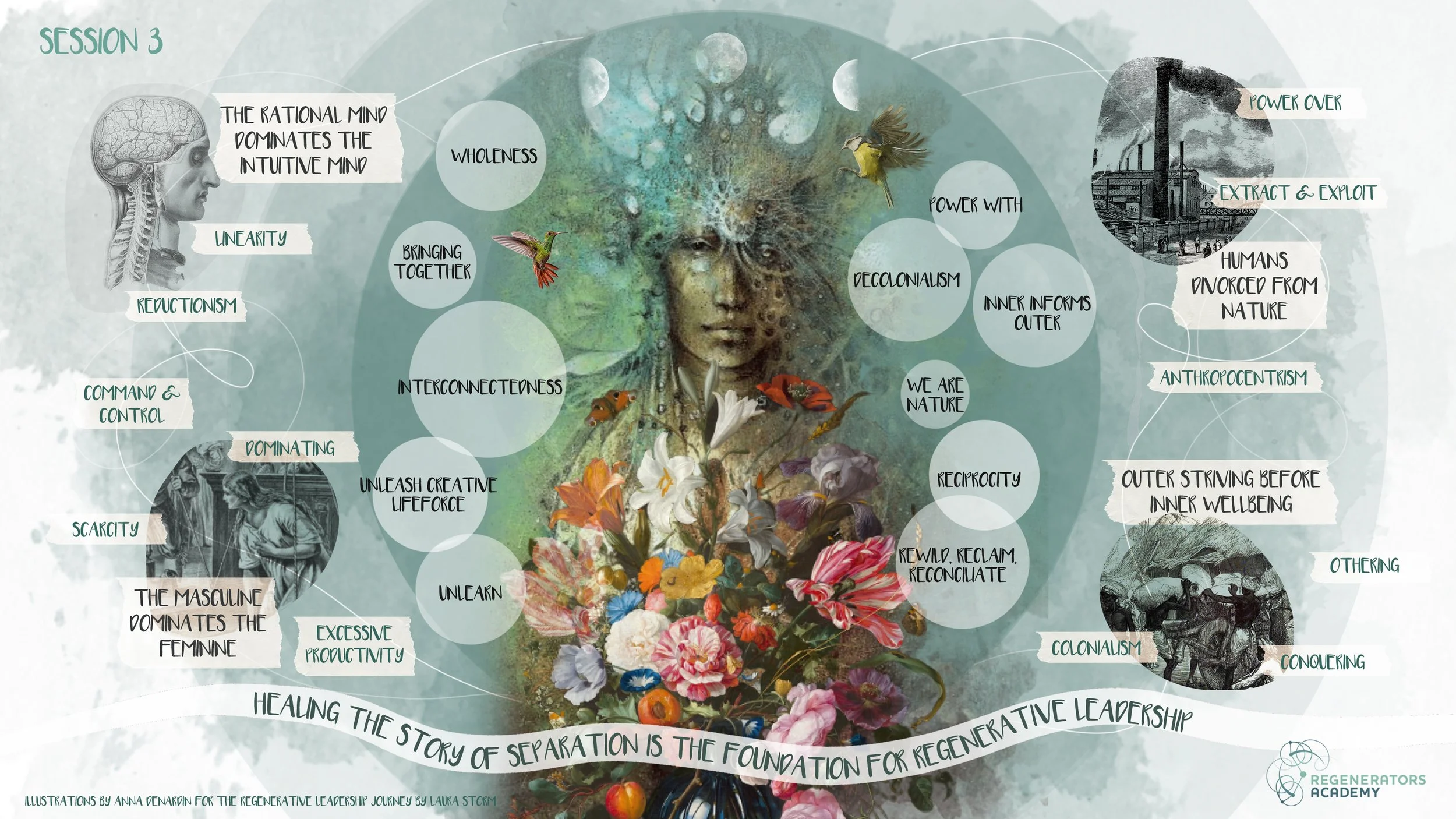
Artwork from the session on the Story of Separation, by Anna Denardin
Why this matters for leadership
If leaders have not examined how colonial patterns live in their assumptions, reflexes, and decision-making, those patterns will continue, no matter how many regenerative words we throw around.
We have seen this repeatedly:
Organizations adopting regenerative language while maintaining burnout cultures
Sustainability strategies layered onto extractive business models
“Inclusive” initiatives that never redistribute power or resources
Spiritual or wellbeing practices used to soothe discomfort and make us more efficient rather than to redesign workplaces and cultures.
Decolonial work helps leaders notice how they lead and whether they are contributing to health, resilience and vitality, or rather extracting and depleting.
It invites a deeper set of questions:
How do we make decisions? Who’s in charge of what and when?
Do we have a culture of trust and belonging?
Whose knowledge is centered, and whose is ignored?
What does it mean to be in right relationship to yourself, to others, and to wisdom and ideas you come across?
What does success look and feel like and what do we accept results will cost us — humanly, ecologically, relationally?
Where am I defaulting to control and scarcity when I feel afraid or uncertain?
These are not abstract questions. They are practical leadership inquiries that we also explore on the Regenerators Journey.
Ask yourself honestly which one it is
Biomimicry, living systems thinking, nature therapy that truly puts life at the center will address colonial patterns either indirectly or directly, or we risk perpetuating harm.
There’s a massive interest in the corporate sector right now around introducing nature therapy, incorporating breaks, and meditation. This is all good, but if those tools and practices are only implemented to make workers more efficient so we can extract more and keep the life-destroying machine alive for longer, then all we have truly done is enabled further extraction.
“Are you enabling more degeneration by keeping the machine alive, or are you nourishing the soil to activate regenerative potential?”
So ask yourself: Are your practices benefitting the mechanistic degenerative ways or fostering more life-affirming ways?
Sometimes the wellbeing initiatives can indeed be a way of getting started, preparing the soil and build a strong momentum that can then lead to the strength, courage, and inner capacity needed to activate deeper systemic transformation. Sometimes it is indeed the best first step. I call this the trojan horse strategy: Enter with wellbeing initiatives to nourish the health of the internal work environment and then when the collective nervous system of the organization is out of high arousal, the soil is ready to receive more transformative systemic seeds.
But ask yourself which one it is: are you enabling more degeneration by keeping the machine alive, or are you nourishing the soil to activate regenerative systemic transformation?

Soil Agreement artwork by Niels Devisscher
The Regenerators Soil Agreement - one of the ways we seek to lay a decolonial foundation in our learning spaces
Because regenerative leadership and systemic transformational work is relational and long-term, we begin our year-long journey with what we call a Soil Agreement.
The Soil Agreement is not a code of conduct or a list of rules. It is a shared commitment to the conditions we seek to cultivate together, among facilitators and journey travellers.
Decolonization is explicitly named in this agreement. Not as an ideology but as something we all commit to weaving into our ways of being together:
“Part of co-creating a flourishing regenerative future requires that I do my best to explore how colonial worldviews, structures, behaviors, and belief systems may be present within me and my communities. We practice curiously exploring where internalized colonialism and capitalism may show up in our worldview and in our micro-actions and behaviors. We train our capacity to detect colonial patterns in real-life scenarios. We practice seeing what we haven’t seen before and accept that healing the Story of Separation is a central task for regenerative leaders, regardless of how uncomfortable this process may be.”
In practice, this means:
Acknowledging that none of us are “outside” colonial systems
Understanding that harm can happen even with good intentions
Committing to listen when we are challenged, rather than retreat into defensiveness
Valuing lived experience alongside formal expertise
Recognizing that unlearning is as important as learning
The Soil Agreement gives us a shared language for accountability, humility, and repair. It allows participants from many cultures, sectors, and worldviews to stay in relationship when discomfort arises,—which it inevitably does. Training our capacity to detect the patterns and being willing to explore these deeper is where real transformative work lies. This is what we will explore deeper in Part II of this series; how colonial patterns show up in ourselves and our work. Sign up to the Regenerators Newsletter to receive it.
Further readings for your decolonization journey:
We’ve been honored to welcome indigenous wisdom keepers, decolonial disruptors, and scholars to the Regenerative Leadership Journey over the years to contribute to this discussion, including Joshua Konkankoh, Bayo Akomolafe, Lyla June Johnston, Ayesha Khan, Sahana Chattopadhya, and Dra. Rocío Rosales Meza.
Some other thinkers, practitioners, activists, and cultural workers who have profoundly shaped contemporary conversations on decolonization, regeneration, and liberation include:
Robin Wall Kimmerer — Indigenous botanist and author of Braiding Sweetgrass and many other books. Her work weaves ecological science with Indigenous teachings on reciprocity, kinship, and care for the living world.
Tyson Yunkaporta — Aboriginal Australian scholar and author of Sand Talk: How Indigenous Thinking Can Save the World, articulating Indigenous design logics as pathways beyond colonial systems thinking.
Possible Futures Collective, including their course Intro to Decolonizing Sustainability.
Dr. Michael Yellowbird — Indigenous scholar and social worker whose work on neurodecolonization, mindfulness, and historical trauma supports healing from colonial violence and the restoration of Indigenous wellbeing.
Vanessa Machado de Oliveira — Author of Hospicing Modernity and Outgrowing Modernity: Navigating Complexity, Complicity, and Collapse with Accountability and Compassion.
Towards Decolonial Futures collective, exploring how to compost harmful systems while cultivating relational, post-colonial ways of being.
Adrienne Maree Brown — Author of Emergent Strategy and other works, developing transformative justice and movement practices rooted in living systems, Black feminism, and decolonial abolition.
Layla Saad — Author of Me and White Supremacy, creating structured processes for white accountability and the dismantling of internalized and systemic racism.
Audre Lorde — Black feminist poet and theorist whose work names difference, anger, and erotic power as vital sources of resistance and collective liberation.
Bell Hooks — Cultural critic and educator who wrote extensively on love, domination, race, gender, and liberatory pedagogy as foundations for decolonial education.
Angela Davis — Abolitionist scholar and activist whose work critiques carcerality, racial capitalism, and reforms that offer inclusion without structural transformation.
Robin DiAngelo - American academic, author of “White Fragility”, and consultant known for her work on race and racism, particularly exploring systemic racism from a white perspective.
This was Part I of Laura Storm's series on the role of Decolonization in Regeneration. In Part II we will explore how colonial patterns show up in ourselves and our work, and offer some reflective questions for your journey into these landscapes. Sign up the Regenerators newsletter to receive it in your inbox.