Planting Seeds of Regeneration For The Lands And Peoples Of Oko Community
-
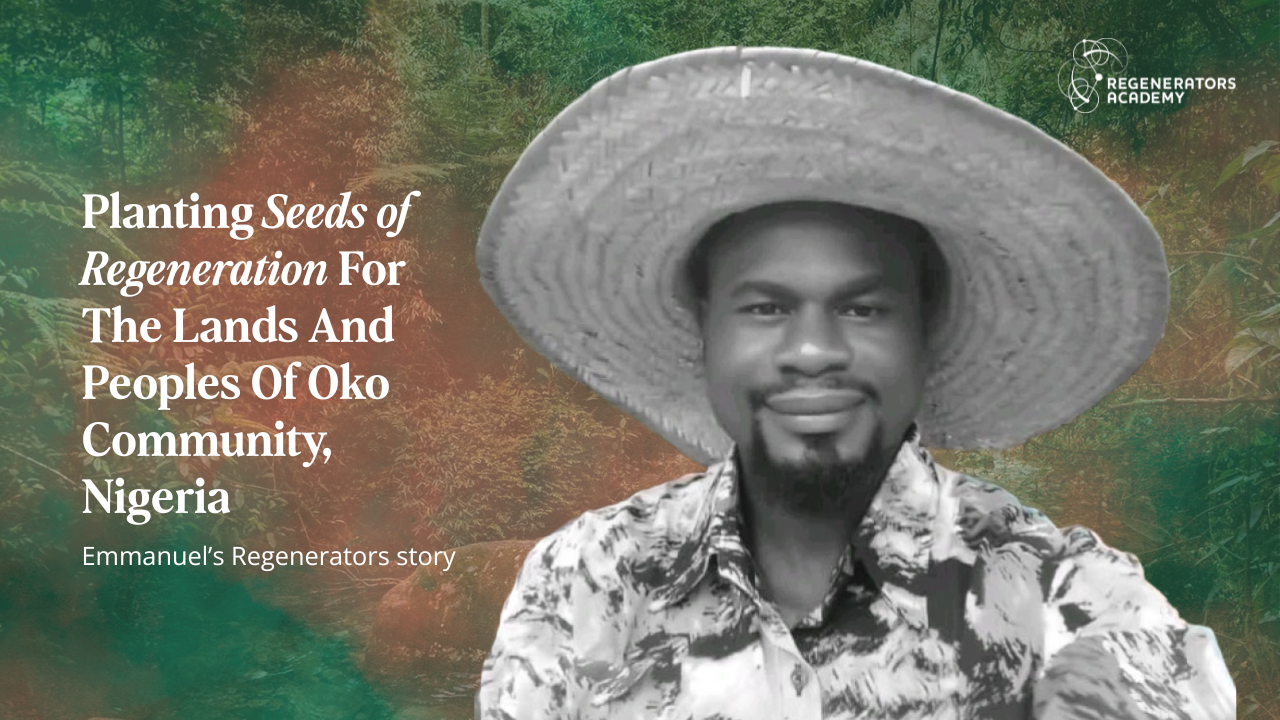
Emmanuel Izuegbunam is the founder of the Akaama Regenerative Community in Southeastern Nigeria. In this community effort, tree planting is transforming the eroded landscape.
He is an alumnus of the Regenerative Leadership Journey 2024.
Emmanuel on LinkedIn.
Words by Shimrit Janes.
Oak always remembers. Oak always holds. To cut oak without asking is to cut spirit, cut ancestor. And once cut, with what are we left? For this is Akaama. Sacred covenant, ancient lands, living alter.
Yet. Soil erodes. Land erodes. Community, connection, all erodes. Without oak’s deep roots, all washes away.
This is a story of Oko, a community in Orumba North Local Government Area of Anambra State, Southeastern Region of Nigeria in West Africa.
This is a story of a land degenerated, degraded. Suffering from the living legacies of colonisation as land and people weep their griefs.
This is a story of humor, rivers laughing, bubbling, blowing breezes of welcome. Of ancestors, memory, spirits of land, water.
This is a story of Emmanuel Izuegbunam, of farmer’s lineage. Land regenerator, ecosystem facilitator, regenerative practitioner. Storyteller, tree planter. Founder of Akaama Regenerative Community. Child of Oko, Igbo man, EzeOdịnanị.
This is a story of how roots hold all.
“Come. Come gather, rest at my roots. Rest a hand against my bark. Be sheltered, shaded by my canopy. Be held, as I hold land, story, memory, spirit. I am of forest. You are of forest.
I am Ngwu, ancestral deity.
Closer, come closer, you know this language, this language of life. Have known since you were child.
Do you know what you are looking for?”
“The land runs, it flows as water, falls away, unheld. Streams dry and die, even as their spirits remain. Waters flood. All is washed away, homes, earth, life. Ancestral groves are destroyed, ancestral wisdoms forgotten. Mindset of coloniser flows too, Odinani ways buried beneath.
All – erodes.”
“I can help you. In Akaama, nothing is forgotten.
Get me, a lot of me, spread us out.
The land will never move again.”
The land and its waters are hurting. And so, its people hurt too.
Emmanuel is remembering. His brother, remembering. His father, remembering. Of how the land was, the waters. The spirits. Others of Oko are remembering, too. The elders who hold within them the folklores of their people. The folklores of Akaama. They all listen to the land, its memories, and how it longs to heal. Others still see those who remember as ‘crazy’, the ways of those who colonized deeply tentacled within them.
Emmanuel remembers the cashew plantations of his childhood. Ask him how things have changed, and the energy darkens, the song in his voice shifts from playful to tearful:
“When we were growing up, it was fun for me. We’d go down to that place, we’d play, visit the streams, come back. We’d visit the cashew plantations. And today, such things no longer exist in that place. They have all been washed away. So, it’s a desolate land, that needs to be regenerated…It’s something that brings tears to my eyes… Human beings around here don’t understand what regeneration means.”
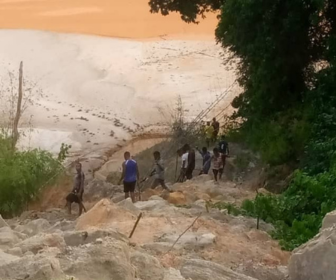
If you walk the lands of Oko, you will find an erosion site. A place where the land descends, craters. Earth falls, unheld. Known as the ‘Oko Grand Canyon’, it is thought to be one of the deepest erosion sites in West Africa.
With erosion, comes flooding. Waters running wild. Streams who have flowed through the land and ancestral memory run dry. New flood paths emerge, washing away earth, trees, homes, lives. The land and its waters are hurting. And so, its people hurt too.
The guardian spirits of the streams remain. But who now visits or hears them in these days? Emmanuel, the elders, others, share their stories. It’s not only the land who needs regenerating.
Emmanuel remembers being led to Akaama stream as a child, with his brother, at 3am by an elder, Asụkwa Geoffrey Ezenduano. The children were curious about what he was doing there every morning. Asụkwa Geoffrey Ezenduano told them to fetch water from the stream, and then did what elders often do: told stories. Stories of how Akaama came to be, stories seeded and rooted in place.
More recently, Emmanuel remembers how he was in a place where a stream used to flow.
“The breeze and trees began to dance to the tune of the wind. There was no other place that was doing that. I didn’t say a word – I knew the spirits were happy that we came. I didn’t say a word, but my younger brother, Chikelue, who was with me, said: ‘They are happy that they have visitors.’
I wanted to be sure, asking, ‘How do you know that?’
He responded, ‘That’s just the truth. They’re happy we are here.’
The spirits are here, very much alive. When you come to that place, you come with white chalk to offer prayers and sacrifices to them. And make your prayer to them. The deities are very much here, they won’t leave. They are spirits of the land.
I communicate with the trees, the water, the stones, to understand what regeneration means. It may be hard for some people, but it’s not hard for me to be able to communicate with trees. They tell me and share knowledge and memory with me. Truly, it’s the trees that can help regenerate this place.”
“I communicate with the trees, the water, the stones, to understand what regeneration means.”
The spirits of Akaama, the stories, the folklores, the trees, lands, waters, stones, are the soils being eroded. And yet, they persist. They want to be heard. They want to heal.
To understand why all is being eroded, degraded, we must delve into roots. Roots of what has changed. And why.
“It’s humans,” exhales Emmanuel.
“It’s us. It’s the engineers, the academics, the professors, the architects, the government. Myself, too. Every one of us contributed to the degrading of this landscape. The way we build our houses, the way we channel flows. The way the engineers design the roads and flood drainages, not considering that this could be harmful to the land. They just channel the flows somewhere… I’m going to tell you the truth.
The people need to understand they’re hurting the land and the people who are living here, and their ancestral homes and lands too.
People will construct a house, and cement the whole floor of the compound, channelling all the water out onto the local road. They don’t care where the water goes, and it creates more erosion down the street. Then they call the government, but the government you’re calling is still a part of you. The engineers working with you are your brothers and siblings.”
Delve deeper still, sink your hands into the soil, feel around roots, mycelium. Feel the quality of the soil between your thumb and fingers. Feel it crumble.
But oak remembers. Oak knows that it and its siblings held land, and can hold land again. Oak planted by Emmanuel’s great-great-grandfather, Ezeagwa, holds the memories of how things were, can be again. Oak planted by Ezeagwa urges Emmanuel to help birth more, more trees, more roots.
Oak has witnessed what changed. Witnessed the arrival of the European colonizers and their ways.
“My people embraced Western culture.” Emmanual’s voice hardens.
“What changed was the way they started looking at nature as something evil, that could be abandoned, and instead look forward to a place when they die – heaven… The idea of a place better than where we are on this planet that we’re living in, this is the reason why my people neglected nature… They see the trees as something evil, that should be destroyed, cut down, without planting more. My great-great-grandfather was more scientific before the entrance of this knowledge of a ‘better place’…
Even the indigenous people here don’t have this knowledge, because they’re still reconnecting back with themselves from what was lost because of the entrance of the colonial masters. They still don’t understand why our ancestors were planting those trees; for the ecological integrity of our land, to revitalize biodiversity.
…The colonial mindset affects the way people measure someone’s worth; value becomes the amount of wealth you accumulate. When you start talking about these things [the land, deities, regeneration, trees], they look at you like you’re crazy.”
Anger. Tears. Pain. You become flooded, as the land does. Descend, fall, erode. As the land does.
As Emmanuel did.
He is incarnation of African Oak.
He is the land.
But, just as he was at the edge, came hope. Oak spoke with him. Urged him to plant and keep planting. For around oak, soil doesn’t move.
And just as trees need their siblings, the soil, waters, sun, the spirits, us, so too are we. We need our siblings. We need our kin. We need our land.
Emmanuel knows this isn’t work for him alone. There is no singular hero here. This isn’t the work of a single generation. This work will be finished beyond his lifetime.
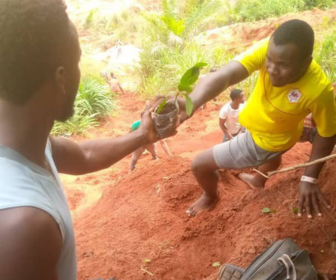
And so. The planting of Akaama Regenerative Community by Emmanuel, so that he and others may in turn plant trees. Plants seeds of remembering. An organization rooted in land, seeking regeneration not only of land, but of people too. To do one is to do both.
The people of Akaama Regenerative Community are working together with land to restore its ecological integrity. Revitalize its biodiversity. They plant and facilitate tree planting, watershed conservation, seeking to reverse the land’s degradation. They seek to collaborate with beavers, who will help heal land and waters through their dams.
But how to restore also the ecology of the people? To uproot the colonial mindset?
Emmanuel speaks of inner and outer regeneration. Of working with youths to help them learn natural processes. Of building a community of care, love and practice.
The people of Akaama Regenerative Community wish for self-leadership, self-awareness, system-awareness across Oko, wider. They are working to create employment opportunities, create forests, collaborate with government, businesses. They are planting education, awareness, research on environmental sustainability, reconciliation, through training, workshops, knowledge-sharing. Nurturing eco-entrepreneurship.
Young people come to Akaama Regenerative Community wishing to plant trees. Wishing to help, as their homes wash away.
In time, perhaps the spirits and stories of the land will bubble up, louder, flowing stronger, as rediscovered streams.
Emmanuel speaks, too, of his international siblings who have helped nurture hope within him. The siblings of Regenerators Academy.
“It was a transformative journey. When the journey started, it was all about the learnings, the things being shared, the stories of evolution, regenerative business models. But the journey matters a lot, being able to connect with people, siblings.
I was lost. When I met the Regenerators, I wasn’t myself, to be honest. I had already lost myself. To trauma, pain, grief. But then, the only thing that kept me moving, pushing, was the thought of regenerating Akaama. I thought if I say to Regenerators, ‘If there’s anything you people can do, please come do it here’, thinking I wouldn’t be here. But somehow, life started coming back to me – somehow, I was regenerated, restored, my soul was restored, everything about me. I began to want to live again. I said, okay. Maybe I have to live so that I can meet my friends one day who have helped me see another side of life again. Maybe I have to live, to implement the learnings from this journey.”
How important it is to feel your own roots meeting others’. And so here too is the birth of a Regenerators gathering in Nigeria, in Oko community. Inviting Europeans, others, back to this land to witness its harms. To witness, too, its healing. To be part of its regeneration.
The leaders of Oko community, the Oko People’s Union, have as of September 2025 written to Akaama Regenerative Foundation giving their full support to their mission. The work can continue without any fear of hindrance.
Tree by tree, the forest grows.
Anger. Tears. Pain. But there is humor here too. Laughter. Joy. Play.
How can such things co-exist?
Emmanuel is joyful. Full of laughter, the birds of the lands and skies in song around him, leaves tickling and enticing.
”Part of it is that humor is in everybody, every human; we just have to find that spot that brings it out. Just as we’re having this discussion, the smiles on your face, the way you handle things, is enough for me to also bring the humor part of me. So happiness is just like that. I like to dissect the walkways to happiness through the lens of Odịnanị.
This is how it is to ignite and remember. How you are connected with environment, sensing, remembering, just like the rivers. There is no time when I step into a river and they don’t welcome me. It’s not possible. There are people who understand ‘the tree is trying to say something, this river’. People without this feel frightened because they don’t understand. The spirits of nature don’t hurt anyone. Rather, we hurt ourselves by blocking or doing things we’re not supposed to do. They never hurt. They always bring laughter to our faces.”
“The Ancestors live in the land, in the water, in the birds, in the thunder. ”
Sometimes when you connect with nature, the butterflies make you smile, the birds too, the humans, the trees.
The spirits of Akaama flow through Emmanuel, the people of Oko. They flow through the stories. Ask Emmanuel to speak of Akaama, and you hear them through him. Ask Emmanuel to speak of folktales, and they breathe through him. This is true regeneration, of land, body, spirit, people. For this, is Akaama.
“Akaama is the Sacred Covenant Between Spirit, Land, and our Ancestors.
In the heart of the ancient lands lies Akaama, not just soil and water, but a living altar — where the spirits of the Land Stewards, Custodians, and Ancestors walk hand-in-hand with the living systems of the world.
It is a place where the boundary between the visible and invisible dissolves. A Liminal space .
Where people walk thresholds
Here, every stone whispers, every stream sings, every tree dreams and dances.
Akaama is not remembered, It is experienced and to enter it with a pure heart is to feel the presence of those who came before — watching, guiding, blessing. And bringing good things to humanity
In Akaama, nothing is forgotten — unless we choose to forget.
The Ancestors live in the land, in the water, in the birds, in the thunder.
To walk in Akaama is to walk on holy ground.
To drink there is to partake in a covenant that stretches beyond time.
When the streams flow, we must offer libation.
When the hill calls, we must listen.
When the forest speaks, we must answer.
When the soil weeps, we must heal.
Akaama teaches us this:
We are not owners of the land.
We are keepers.
We are not separate.
We are part of the greater web of life.
We are not visitors.
We are family.
And so, We Remember.
And by remembering, we restore.”
Engage further:
Do you wish to support regenerating, rewilding and conserving Oko community landscapes?
Emmanuel shares that Akaama Regenerative Foundation is looking for:
1. Individuals, professionals, and organizations that can partner with us in designing, establishing, and running a state-of-the-art Regenerative Vocational Academy.
2. Tree planting: We need partnerships with organizations and individuals that will help us in creating a forest and solving the food crisis in our local communities.
3. Organizations that can partner with us in training our youths in Regenerative Leadership approaches to Life.
4. Organizations and individuals that can partner with us in creating beaver dams and flood control.
5. (Un)Learnings that can integrate food productions through regenerative agriculture into our indigenous cultures and traditions.
6. We are looking for organizations, individuals, and institutions that are ready to support our projects with beavers, materials, money, manpower etc.
7. We need support in creating websites, social media platforms/handles, especially LinkedIn pages, Instagram etc.
8. We need partnerships in creating forest guards collaboratively with the government.Get in touch if you’d like to participate in the upcoming gathering of Regenerators in Nigeria.
Listen to Emmanuel speaking with fellow Regenerators alumni Miriam Dahmane on the When Nature Talks podcast.