Colonial Patterns That Hide Within All Of Us
Disclaimer: This piece is not an academic or comprehensive education on colonialism, empire, racism, or neo-colonialism. There are many scholars, activists, and thinkers who have devoted their lives to this and I highly recommend you engage with their work. You can find a list at the end of this piece.
This article is an invitation into a practice of noticing. Noticing how colonial patterns do not only live in institutions and history books, but are also embedded into culture, leadership models, workplaces, and in our relationships with ourselves and others.
I am not writing this as someone who has it all “figured it out”, or to shame and judge others. I’m writing this as someone who’s on an un-learning journey. The invitation is to begin practicing naming these things so that they become visible.
This is part II of Laura Storm’s two-part series on decolonization and regeneration, which starts with part I: Why decolonization is woven into our Regenerative Leadership Journey.
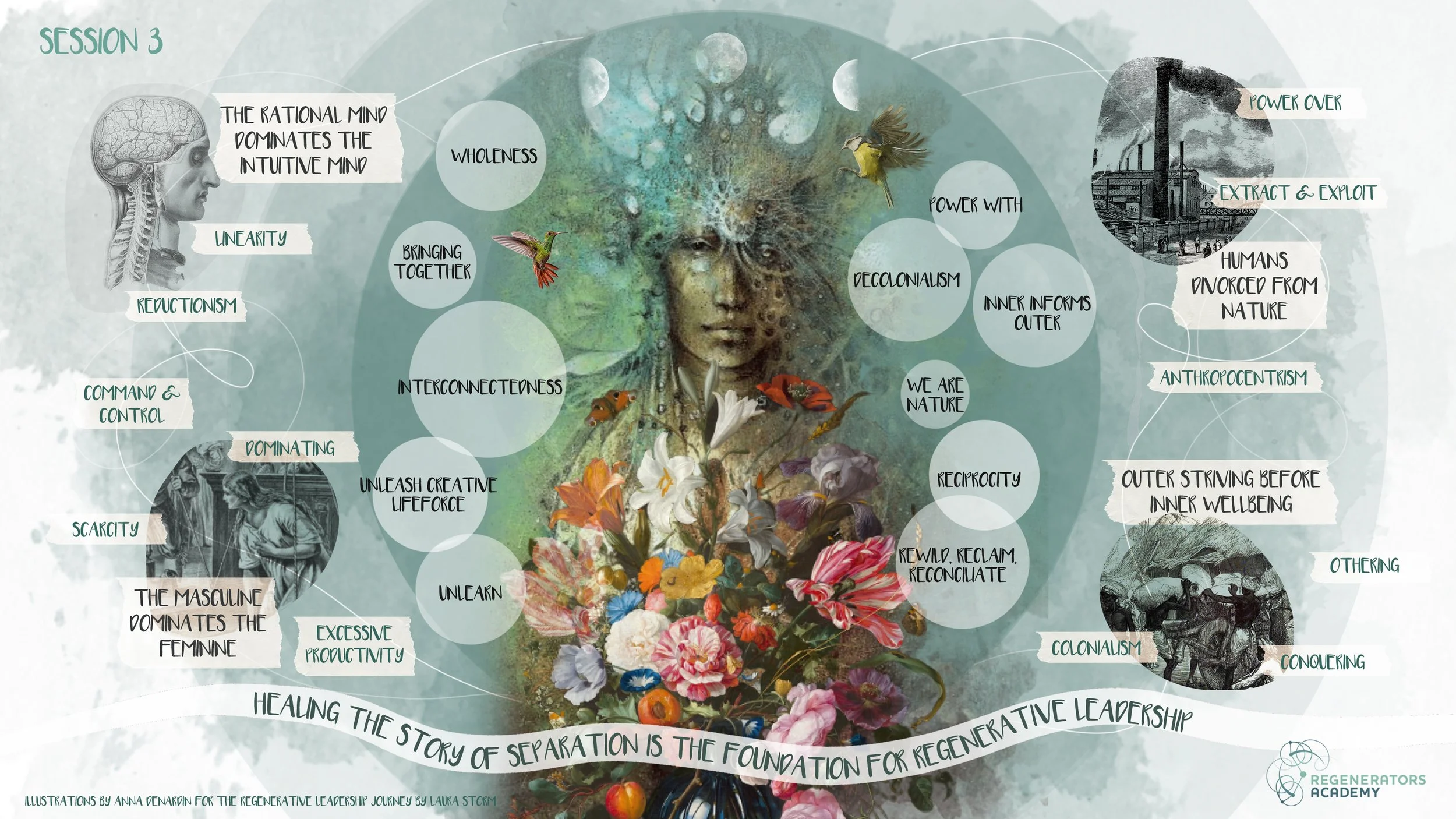
Illustration from the Regenerative Leadership Journey by Anna Denardin
Learning to see colonial patterns
In my own ongoing journey of learning to see colonial patterns in myself, my relationships, and the structures around me, one thing has become clear: they live within all of us.
What has changed for me completely in the past few years through the work of Layla Saad, Dra. Rocío Rosales, Robin DiAngelo, and others is that my dream of a regenerative future, will never be possible until we start seeing how our societies are soaked in colonial patterns. That all of our good work promoting a life-affirming way forward have very little long-lasting effect until we start to dismantle colonial patterns as they stand in the way.
We can start by seeing how they are hiding in plain sight.
Colonial patterns are not “out there,” belonging to bad people in the past or bad/wrong/low-vibe people of the present. Every corner of our society is shaped by them, and understanding this massively increases our ability to make the regenerative future we long for actually possible.
“We can all contribute to dismantling these patterns. And it starts by practicing our capacity to spot them within ourselves and the systems we are a part of.”
On the Regenerative Leadership Journey, we practice becoming detectors of colonial patterns — not to shame, judge, or position ourselves as better than but to awaken collective awareness and practice this essential unlearning together.
Below are a few examples (not a complete list, that would fill a book) of colonial patterns that may feel “normal” because they’re so deeply ingrained in us. The good news is: we can all contribute to dismantling these patterns. And it starts by practicing our capacity to spot them within ourselves and the systems we are a part of.
1: Power-over, mechanistic hierarchies of domination and control
Colonial systems are organized around domination, control, ownership and hierarchy — where a few decide for the many, and authority is concentrated among a few rather than shared. Power-over shows up as top-down leadership, expert culture, compliance, and the conviction that control creates order and efficiency. Under a colonial cosmology, hierarchy is seen as natural, desirable, and inevitable. These patterns show up everywhere:
• Leader over worker
• Humans over nature
• White over global majority
• Men over women
• Mind over body
• Rational analysis over intuition
• Speed over slowness
• Individual over community
“Control and domination strips us of radical wisdom, evolution, and life-force energy and contributes to toxic, manipulative, fear-based cultures.”
These hierarchies suppress the abundance of life itself by restricting collective intelligence and the wisdom that is unleashed when decision-making is not confined to a few suits behind closed doors, but rather accessed by tapping into the wisdom of the field (organization, whole team, community) . Control and domination strips us of wisdom, evolutionary emergence, and saps our life-force energy and often contributes to toxic, manipulative, fear-based cultures.
When we heal that pattern and practice our capacity for leading in a way that honors life and vitality – In Regenerators we call that Regenerative Leadership – we can tap into the organizational field and allow wisdom to surface from unexpected places.
When Jos de Blok, Founder of Buurtzorg and guest teacher on our year-long journey, speaks about making decisions and strategies through listening to the collective field of his organization, and that his main role as the CEO is to listen – this is what it’s about: holding space for emergence, not by bulldozing your way forward and ignoring those with the embodied experience on the ground, but by listening deeply to the wisdom of the whole living system. Don’t mistake this for consensus-based decision-making where we all have to agree before we can move forward. It is a living systems approach to sense-making and co-evolution that simply means we make wiser decisions.
Moving beyond power-over requires letting go of what Bayo Akomolafe calls the colonial rush toward solutions, where the capacity of deep listening, seeing wholeness, sitting with tension, and holding space for emergence are seen as threats and an inconvenience rather than key leadership capacities.
Reflective questions for your journey:
Where do I default to control rather than collaboration - especially when stakes feel high?
What parts of me believe I need to control in order to feel safe?
How does my nervous system respond to disagreement or slow processes?
What would I lose - or fear losing - by sharing power?
2: The outstanding individual – colonial individualism
The fragile individual stripped of true belonging and community needs to get ahead, needs to own, needs to dominate. One of the most enduring yet invisible inheritances of colonialism is what political theorist C.B. Macpherson called possessive individualism - the idea that the individual is the fundamental unit of society and that the primary way one comes to exist is through ownership; of land, labor, body, time, ideas, people.
In a colonial worldview the individual is defined and exists through their possessions and titles.
This logic creates a subtle yet pervasive anxiety: to be someone is to accumulate, to compete, to outperform. It’s also how Darwin’s theory was distorted into “survival of the fittest,” meaning dominance instead of adaptability, flexibility, and collaboration, as was his intent.
Before the colonial project, most human societies understood the self as nested within kinship, land, cosmology, and responsibility. You were not a “self-made” individual; you were a being woven through story, ancestry, ecosystem, and reciprocity. Colonial cosmology relies on the assumption of threat, fear, rejection, and scarcity. Not enough land, not enough resources, not enough power.
“Colonial culture rewards achievement over contribution and is reinforced in narratives like: ‘be the best,’ ‘stand out,’ ‘become extraordinary,’ and ‘leave a legacy’.”
In organizational settings, this pattern of possessive individualism and scarcity shows up as:
Competitive self-maximization
Seeing titles and possessions as self-worth
Secrecy and weaponization around knowledge
Territorial oppressive behavior around roles and positions within the hierarchy
Stealing other people's ideas or work and presenting them as your own
Distrust in community and commons
Savorism lacking respect and right relationship
Possessive individualism also fuels the obsession with the hero, genius, and savior — narratives that elevate individuals, while belittling or diminishing the collective. Colonial culture rewards achievement over contribution and is reinforced in narratives like: “be the best,” “stand out,” “become extraordinary,” and “leave a legacy”.
Most people in the western world are so trained to get ahead, be seen as the smartest, win at every expense — the dog eat dog, zero-sum, scarcity game — that they don’t see anything wrong with, for example, coopting other people’s work or erasing them. We proudly call it “winning the game”.
When people put me on a pedestal or assign me the role of expert, I feel made into a thing, no longer with the freedom to be imperfect, mess up, and make mistakes. This pattern of putting (often self-claimed) “experts” on pedestals dehumanizes everyone involved: those idealized are denied complexity, vulnerability and human messiness, while others are subtly positioned as “less than.”
Regenerative practitioners can help be an antidote to the harm done by the colonial pattern of scarcity and narcissistic individualism by:
Being in right relationship with what inspired you – acknowledging sources doesn’t make you less worthy but more trustworthy and credible and it builds trust and reciprocity in the relational field
Honoring indigenous legacy, rituals and lineage without cultural appropriation
Shifting from ownership to stewardship – tending to ideas, communities, and ecologies rather than claiming them
Moving from hero to host – facilitating conditions for thrivability in the living systems you are a part of rather than seeking awards and accolades
Centering contribution over accumulation – measuring success through what you regenerate and the value you add, not what you possess or the amount of money you make
Practicing accountability and repair – taking responsibility when harm or extraction occurs instead of defending or ignoring.
Reflective questions for your journey:
What knowledge or practices do I draw on and am I in respectful right relation with these?
What fears might arise for me around visibility, position, belonging, or legitimacy if I fully acknowledged the lineages and wisdom I’ve been inspired by?
How might my work change if I rooted my authority not in appearing original or exceptional, but in reciprocity, humility, and relationship?
Who do I place above myself as “more evolved,” “more awake,” or “more qualified,” and what does that cost me, or them?
3: Burnout as extraction and separation
Many people are today in a colonial relationship to their bodies. They extract and extract their physical, emotional and spiritual bodies, shaming the nourishing pause and much needed break. Speed, urgency, acceleration are all a pervasive colonial and industrial era inheritance where urgency is a moral good, efficiency the unquestioned ideal, and around the clock availability expected.
Many have this deep-rooted sense of self that they are only worthy if they are productive and efficient. Gosh, this is a deeply wired programme in me that I still struggle with all the time, although I have worked on this intensively for over 10 years now. The guilt and the shame that can creep in when I feel I’m not efficient and productive enough runs deep yet I’m very committed to weaving in all seasons in every day, spend time in nature, being in tune with the phases of the moon. I practice and still the pattern runs deep.
Just as colonial economies treated land as an infinite resource to exploit and dominate, modern work cultures treat human resources as endlessly renewable - until we collapse and are discarded and replaced as a spare part in the machine.
“The very systems that exhaust our bodies and minds have now devised ways to sell our healing back to us. We can purchase and consume to mitigate the toll this system takes on our psyche and bodies: the fancy spa-treatment, the meditation-app, the expensive yoga studio.”
Burnout, stress, and an overwhelmed nervous system are not personal failures or a time-management issue. It is a systemic outcome of an extractive culture, internalized into our nervous systems and psyche.
The very systems that exhaust our bodies and minds have now devised ways to sell our healing back to us. We can purchase and consume to mitigate the toll this system takes on our psyche and bodies: the fancy spa-treatment, the meditation-app, the expensive yoga studio. I believe the real medicine lies in remembering our indigenous relationship to land, remembering community, remembering that we are cyclical beings on a cyclical planet collectively craving reconnection to our natural rhythm and habitat. Colonial time is linear and progress-oriented and when we live like that we are never truly here in the present moment but live in the future always in a hurry never really good/efficient/clever/successful enough. Ecological time is cyclical, with cycles and seasons, rhythms and honours spaces for rest and regenerative, reflection and integration.
When we start seeing this pattern for what it is we can start to redesign our work and life based on how we create conditions conducive for health and thrivability.
Exploring a more cyclical approach to our life and work is the antidote to colonial burnout and I think it would make a powerful difference if psychologists, therapists, coaches, and nature therapists who help people navigate stress, anxiety and burnout understood that these are symptoms of a colonial industrial extractive logic. I think seeing this would create relief for those navigating burnout. That it’s a systemic failure - not an individual one. Maybe we wouldn’t see the devastatingly high numbers of stress and burnout if we understood that an essential part of the antidote is remembering the indigenous ways of nourishing your relationship to land, your community, and honoring a cyclical approach to life. Integrating rest, and reflection, and play, and frolicking.
Reflective questions for your journey:
Where in my life do I treat my body, my time, or my attention as a resource to be extracted from and optimized rather than a living system to be tended and nourished?
What signals of exhaustion or misalignment have I learned to override in the name of productivity, usefulness, or worth?
What is my relationship to taking a break, pause and rest?
4: Commodified new age spirituality and appropriation that strips us of wholeness, reciprocity and right-relationship
The “love and light” wellness industry — crystals, palo santo, white sage, cacao — sometimes lacks relationship to the cultures, people, land, resources, and labor involved.
If this triggers shame or anger, know that I’m not saying you can’t smudge, drink cacao, or have a crystal. The invitation here is to develop a relationship to the web of relations involved in your spiritual tools and the lineage you draw from. Your plant medicine, rituals, tools, and expressions like “namaste” and “aho” come from cultures and lineages that never agreed to being culturally appropriated to the extent the white wellness culture has done. There is most often than not no accountability to the people, land, or cosmology from which they originate — only extraction and consumption.
Where Indigenous spiritual traditions emphasize belonging, responsibility, and reciprocity, New Age spiritualism emphasizes self-healing, personal vibration, and individual ascension — mirroring the colonial, narcissistic, possessive individualism described previously. Decolonial regeneration insists that healing without justice is incomplete and that grief, sadness, and anger are not “low-vibe” failures of consciousness, but essential responses to the world we currently live in.
Grief is transformative — Bayo Akomolafe called it an inflection point when he joined us on the Regenerative Leadership Journey in 2023. Grief when held and witnessed opens dimensions within us that the polished spiritual spaces of love and light cannot. Grief has the capacity to soften us, to stop us in our tracks, and to make us finally see what we are doing to ourselves, to one another, and to the more-than-human world. Without grief we cannot feel the rupture, and without feeling the rupture we cannot choose a different path. What we are left with in these new age spiritual spaces is often something that to me feels like witnessing a performance where you have to play the part to fit in and belong.
“We weave decolonization into our Regenerative Leadership Journey because we are not interested in producing better-branded versions of our current dysfunctional systems and structures.”
I’m not addressing this to spread shame but to encourage reflection on our own behavior. As Dra. Rocío Rosales who was a guest facilitator on the Regenerative Leadership Journey in 2025 shared to the cohort when grief, sadness, and shame was activated in the session with her:
“Do better because it's the right thing to do and not because you feel guilty and ashamed. It’s critical for white people to deeply understand that “love and light” is not gonna cut it as it’s bypassing the deeply underlying root cause of the systemic oppression and extraction we see today”.
We need to roll up our sleeves and get to work. Do the deep colonial shadow work and confront it head on so we can transmute it and dismantle it. Disentangle. Which is why we have to go to the roots unless we want to continue scaffolding solutioneering practices on fragile, unhealthy foundations.
Reflective questions for your journey:
Am I in right relationship with the practices I preach, the tools I use, the rituals I enjoy? What do I offer back to the lineages or peoples I draw from?
Does my spirituality make me more relational, more responsible, and more available for repair?
What happens in me when grief or rage enters the spiritual space?
An invitation to Regenerative Leadership
In our Regenerative Leadership Journey we practice spotting colonial patterns and through that process create space within ourselves to develop our regenerative leadership capacities. Regenerative leaders help move away from the colonial narcissist and into a life-affirming way of holding space.
A move from:
1. Superiority → Humility
Ability to listen to others and the willingness to be wrong.
2. Fragility → Accountability
Capacity to receive feedback, repair harm, and stay in relationship under tension.
3. Exceptionalism → Belonging & Participation
Understanding oneself as part of a collective, not above it.
4. Extraction → Reciprocity
Nourishing a field of abundance by giving back; honoring cycles of contribution and paying it forward
5. Visibility-as-worth → Contribution-as-worth
Shifting from only being worthy when seen and celebrated to “serving the larger field” also when no one sees your good deeds
6. Ownership → Stewardship
Ideas, land, teams, and resources are tended and nourished, not possessed.
7. Entitlement → Responsibility
Power is held with care, not assumed as a right.
8. Disembodiment → Embodied Presence
Leading from a nervous system capable of sensing, attuning, and responding.
9. Ahistoricism → Lineage & Context
Understanding the greater ancestral lineage of the practices and rituals you work with and bringing that wisdom into your spaces respectfully
10. Heroism → Activating the Field
Letting go of the quest of saving the world to activate a greater collective field of abundance and potential
This is why we do this work
So to summarize and answer the question posed in Pt.1 of this blog: we weave decolonization into our Regenerative Leadership Journey because we are not interested in producing better-branded versions of our current dysfunctional systems and structures. We have it as part of our foundational soil because we need to collectively become more aware about our cultural patterns and norms so we can dismantle these in service of life-affirmings futures.
Learning to sit with discomfort, not rush past it
I could write a whole book about colonial patterns to be aware of, especially for those of us committed to contributing to societies rooted in regeneration, whatever that may look like for you. I recommend again you study further with the practitioners I mention below. We have in this piece covered some of the most common ones: scarcity-thinking, zero-sum game, power-over, exceptional individualism, spiritual bypassing, white supremacy, saviorism, extraction of land and body, domination, fear-tactics, worth as ownership, appropriation, tokenization, commodification of culture, urgency, separation and superiority.
Decolonial work is uncomfortable, especially for those of us raised within dominant Western systems. It can stir grief, shame, anger, confusion, and resistance. Where I stand with this is that I don’t want to contribute to polishing the destructive surface. I also fully believe that there’s no one way of doing this, and the main task is to be aware of these patterns so you can see them and help consciously heal and dismantle them. You don’t have to use the word decolonial or colonial if that doesn’t feel right for you but my invitation to you is to educate yourself in these patterns by engaging with some of the wisdom keepers, decolonial disruptors, and scholars mentioned below. I promise it will be a humbling, transformative, and eye-opening exploration.
If my words have offended or triggered you, I hope you see it as an invitation.
Further readings for your decolonization journey:
We’ve been honored to welcome indigenous wisdom keepers, decolonial disruptors, and scholars to the Regenerative Leadership Journey over the years to contribute to this discussion, including Joshua Konkankoh, Bayo Akomolafe, Lyla June Johnston, Ayesha Khan, Sahana Chattopadhya, and Dra. Rocío Rosales Meza.
Some other thinkers, practitioners, activists, and cultural workers who have profoundly shaped contemporary conversations on decolonization, regeneration, and liberation include:
Robin Wall Kimmerer — Indigenous botanist and author of Braiding Sweetgrass and many other books. Her work weaves ecological science with Indigenous teachings on reciprocity, kinship, and care for the living world.
Tyson Yunkaporta — Aboriginal Australian scholar and author of Sand Talk: How Indigenous Thinking Can Save the World, articulating Indigenous design logics as pathways beyond colonial systems thinking.
Possible Futures Collective, we highly recommend this course and their podcast.
Dr. Michael Yellowbird — Indigenous scholar and social worker whose work on neurodecolonization, mindfulness, and historical trauma supports healing from colonial violence and the restoration of Indigenous wellbeing.
Vanessa Machado de Oliveira — Author of Hospicing Modernity and Outgrowing Modernity: Navigating Complexity, Complicity, and Collapse with Accountability and Compassion.
Towards Decolonial Futures collective, exploring how to compost harmful systems while cultivating relational, post-colonial ways of being.
adrienne maree brown — Author of Emergent Strategy and other works, developing transformative justice and movement practices rooted in living systems, Black feminism, and decolonial abolition.
Layla Saad — Author of Me and White Supremacy, creating structured processes for white accountability and the dismantling of internalized and systemic racism.
Audre Lorde — Black feminist poet and theorist whose work names difference, anger, and erotic power as vital sources of resistance and collective liberation.
Bell Hooks — Cultural critic and educator who wrote extensively on love, domination, race, gender, and liberatory pedagogy as foundations for decolonial education.
Angela Davis — Abolitionist scholar and activist whose work critiques carcerality, racial capitalism, and reforms that offer inclusion without structural transformation.
Robin DiAngelo - American academic, author of “White Fragility”, and consultant known for her work on race and racism, particularly exploring systemic racism from a white perspective.
Doors to join the Regenerative Leadership Journey 2026 close on 27th January 2026.