Healing Through South-North Partnerships: Creating A Home In The African Peace Village
-
Joshua Konkankoh is a Cameroonian elder, community organizer, and a founder of the African Way Association. He previously developed Cameroon’s permaculture Bafut Ecovillage, which was destroyed during the country’s ongoing conflict, and is now a refugee in Portugal.
He is an alumnus of the Regenerative Leadership Journey 2022.
Konkankoh on LinkedIn.
-
Heide Maria Baden, born in Germany, is a geographer and living climate ecologist. After living in Denmark for 13 years, she is now working with Konkankoh in Portugal. She is a co- founder of the Listening to Rivers Alliance (LiRA), as well as one of the co-initiators of a growing circle of scholars in transformative learning practices at the intersection of community and the academy.
She is an alumna of the Regenerative Leadership Journey 2022.
Heide on LinkedIn.
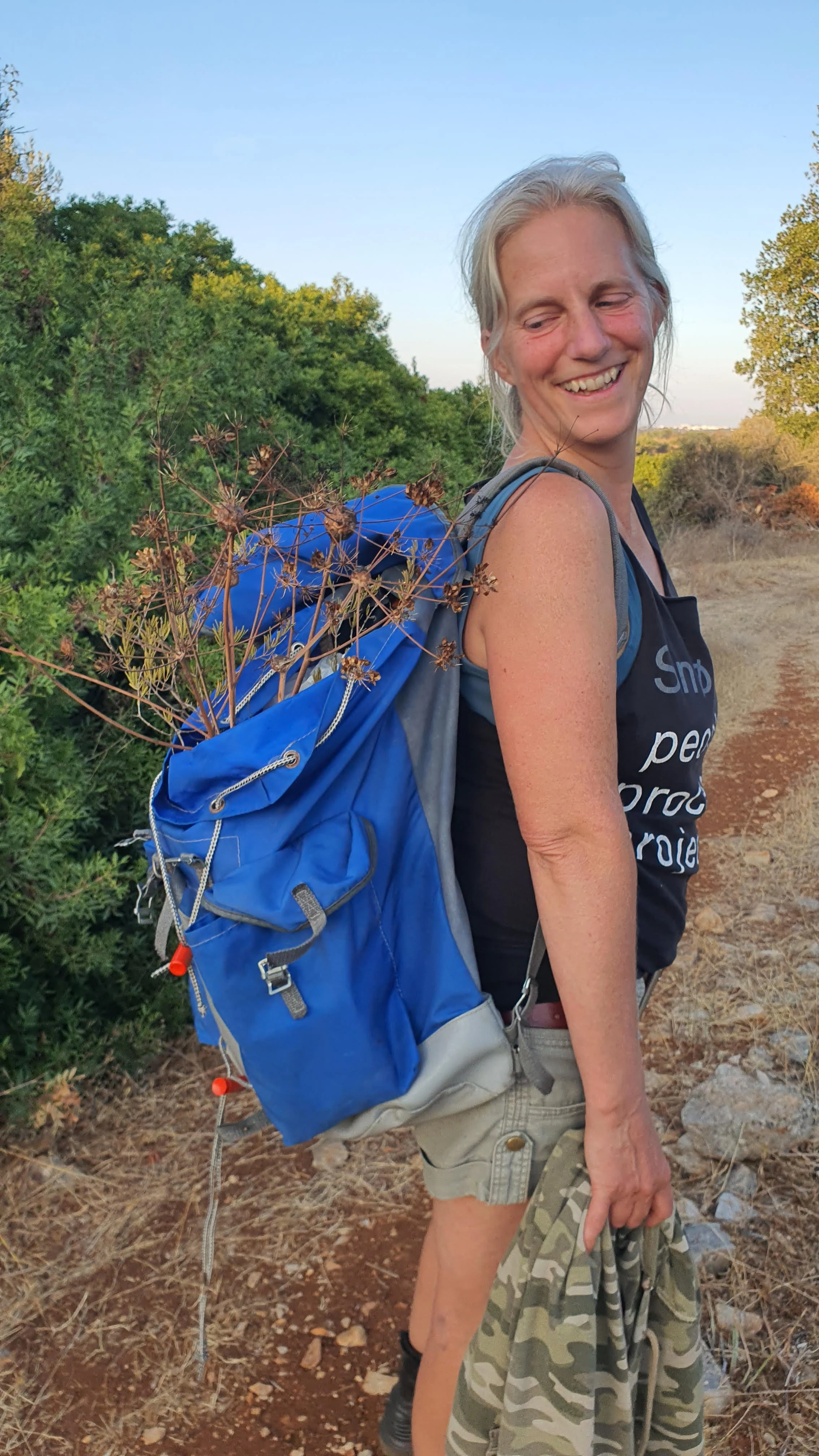
“What are you seeing? What is the story of these plants in your bag?” Konkankoh playfully asks.
“They are butterfly bush. There’s something going on here,” Heide reflectively answers, gently touching the stalks with their clustered heads. “It’s evolution. New planets are forming in our solar system.”
Within this simple exchange lives everything that exists between these two humans.
A walk. A question, an inquiry, an exploration. A coming together of worlds, lands, experiences, plants, stars, universes. Forming new constellations. New galaxies.
What happens when a man who is African, Cameroonian, Indigenous Elder, refugee, and a woman who is European, German, academic plant ecologist, immigrant, come together? What edges are met? What becomes possible? What can be healed? Regenerated?
What becomes born?
Which Lagos?
“If you type ‘Lagos’ into your browser, and don’t put PT – which means Portugal – then you land in Lagos, Nigeria.”
Heide and Konkankoh are joining our call from Portuguese Lagos, not far from the abandoned cooperative they are seeking to restore together through the African Peace Village project.
And Konkankoh is speaking to the thread that ties these two cities together, a tie etched in trauma and slavery.
“Why Lagos? It all started here. We cannot regenerate if we don’t think about the Berlin Conference, and what it created between Lagos in Nigeria, West Africa, and this Lagos, in what we call Iberia… the first slaves from West Africa landed here. If we really, truly want to talk about regeneration, about South-North partnerships, then this project [the African Peace Village] is at the pivot between Africa and Europe where it all started. This question of talking about regeneration without addressing human rights, it’s become for me a real struggle to understand what we can actually do.”
If you search for Lagos, you land in Nigeria. On the coast of West Africa, which became a focal point for the capture, holding, and shipment of enslaved people.
If you search for Lagos, you land in a place known in its indigenous Yoruba as Èkó. But language can be colonized too. It is thought perhaps the land became named lagos – ‘lakes’ – by a Portuguese ‘explorer’ in 1472. Or perhaps for the Portuguese Lagos, the first European entry point for enslaved people and home of Europe’s first slave market.
These colonial histories don’t live in the past. Konkankoh’s experience as someone seeking ‘refuge’ in Europe is witness to this, as his role and experience of Village Elder is subsumed by a new identity enforced on him: refugee. With all the connotation that this word carries in the West.
A coming together of worlds
Wednesday, 9th March 2022.
Konkankoh joins a call with the first cohort of the Regenerative Leadership Journey, to share his story. We are gathering on ‘Healing the Story of Separation’, and are still early in our year-long journey.
He shares his experience of being invited into initiation in his village in Cameroon at 13 by the elders. He shares his experience of the European missionaries coming to his village, declaring the ancestral wisdoms of the land and its women as heretical, enforcing Bible and Christianity in their place.
He shares his experience of going into the forest, following rivers, meeting ancestors amongst the trees, pouring libation. And he shares how separation began with the silencing of women.
His voice trembles at moments. His eyes twinkle at others. And he brings with him burning candle as sun, dried branch and living branch as colonization, white flowers from the land he now finds himself on, so far from the home of his village. All to show us what can’t be told.
Friday, 18th March 2022.
A call comes out over email to the Regenerators, asking for support for Konkankoh’s new project in Portugal.
And a woman, Heide, feels the pull from within her; the gravity of one planet pulling another closer into its orbit.
It had been Heide’s sister who had first introduced her to Laura’s work the year before, after seeing Laura speak. “You have to take that course,” came the words, one sister to another.
“And I was just getting out of work at the end of 2021. My job was over, so I didn't have time and I didn't have money [to join the Regenerative Leadership Journey], but I was thinking about it. And then there was this scholarship that Laura was giving and it was a stormy night in February that I thought, this is it. I'm doing it. I have to go. Somehow, some way. I had to do it.
And then I met Konkankoh, there that day that he told his story about Bafut. And then the question was: how do we continue? How does this work go forward? What can I contribute?”
An exploratory session on Strengthening South-North Partnerships is held in June, for those who wish to know more, to support.
Over four years later, Heide is still here, alongside Konkankoh; in person now, rather than over Zoom.
A new solar system is formed.
What are we regenerating?
“Really, what are we regenerating?”
It’s a question Konkankoh returns to in different ways, carrying it through our conversation with him, through life with him. The question is a seed, an heirloom, a branch, held and offered by someone who knows and has experienced the joys and practicalities of community building, as well as the pains and traumas of displacement, of separation.
“What I am doing with Maria [Heide Maria], it’s about something practical. How do people with broken relationships live together? How can they use their example to restore healthy relationships? Maybe it’s a very small level, but it’s an experiment that should inspire the way we do research.”
Konkankoh and the Better World team launched The African Peace Village project in 2020. Now, Heide and an increasing number of others are actively co-building the project, with their bodies, minds, stories, and seeking to bring together different wisdoms to show the art of the possible. To show what a refugee/immigrant-led regenerative project looks like. To create a place where people can actively practice and experience regenerative ways; not as theory, but with their muscles moving, face turned to the soil and sky, in partnership with the land.
“There’s a big, old carob tree and also a mulberry tree. I’ve sat under them, and listened to the bees. The bees are very wise. And what I was hearing was also the African drum.
The history of this land was cooperative. And this act of cooperation and production talked a lot to me. Then the corporates came, and the local culture disappeared, the farmers. The river that gave the name of this place has become a dry valley.
And so, I felt that I had found a place for the Regenerators to actually practice what they are talking about, hands on.
We've taken it upon ourselves to restore a ruin that has been abandoned in Southern Portugal, near Lagos here, where we are. This ruin still carries remnants of natural building, of organic agriculture. It was designed with permaculture; it was a cooperative for some hundreds of years. We're trying to look at this history and whether we can restore what served people and is still healthy, and maybe introduce some innovation.”
The work isn’t easy. The partnership between a Cameroonian Elder refugee and a German academic migrant isn’t always easy. Funding – so often funneled to those without hands in soil, to those without lived experience, to those harmed, and those healing – isn’t easy.
But this is what Heide and Konkankoh are forming together. Part of their commitment to ‘agreements of discomfort’ rather than ‘agreements of convenience’. And it exhales in the space between them as they look to each other with smiling eyes.
Healing through partnership
Elder-Academic, South-North, in partnership.
Konkankoh feels and sees the deep tension between the two on these European lands.
“What is eldership all about? Because I know that in this society, in this part of the world, I’m now learning what Europe is, and the West. And I see a lot of similarities with what the West has installed in Africa…
So this question of the role of eldership in Europe has been pre-occupying me… It really aches my heart to see what happens to elders here who should be leading, orientating, advising the children of today, who are in trauma, kept away, trapped away to burn as a living library.
I grew up on the land and I grew up with elders who downloaded into me the role of elder from the ancestors. And what has been handed down through millennia is what makes Africa still remain Africa, no matter that there’s been land-grabbing, everything taken away.
And there’s another part that I’m still struggling with, which is what being a researcher means. What do they actually research, when there are pertinent issues rocking life? Be it on the ecological perspective, or the human level – these are not being looked into because research is looking the other way.
I’ve been a refugee in Europe, and so am interested in the plight of refugees and immigrants. I don’t think research has done enough to see what they bring. I often say they are the real experts of climate change, of regeneration, if we are serious about what we are talking about to regenerate life.
Our mission with the African Peace Village is to lift the young generation, inspire youth and women leadership, and invite them into eldership.”
Heide’s own learning has been in plant ecology, a PhD pinning the prefix ‘Doctor’ to her name. And amongst the deep academic learning she has achieved and that she’s bringing to bear for this project, she is also learning how much she has to unlearn. Within her, too, is this reckoning between academic and Elder, South and North.
“The Western mindset really is a ‘set’. It’s not a flow, is it? It’s really a mindset that we have to contend with, that I have to overcome [in this partnership with Konkankoh] when I get into this place of linear thinking.
We have no idea as humans what we are doing when we cut down a tree. Because we don’t even know the age of that tree. We just cut it. We don’t consider other life forms, cycles, times and data.
When I’m thinking about what this journey is, then it’s mostly one of letting go. Of having the privilege to allow myself to let go, because there’s so much I have to unlearn.
We're practicing this and sometimes it's really convincing, you know? You let go, you let go, you let go and all of a sudden everything, boom, boom, boom happens very naturally as, as it should.
But it's also a friction because we're still also living in this other world of how things are made to happen. How money is made to move.
It’s a way of learning for me to give myself more space to be. When we take the space that is ours in this world, which has been annexed by patriarchy, by capitalism, by colonialism, by all those isms that have taken.”
Regenerating is never only about one thing. Regenerating land means regenerating the self. Decolonizing land means decolonizing the self. To regenerate means, ultimately, that there exists a need to heal from that which has been degenerated.
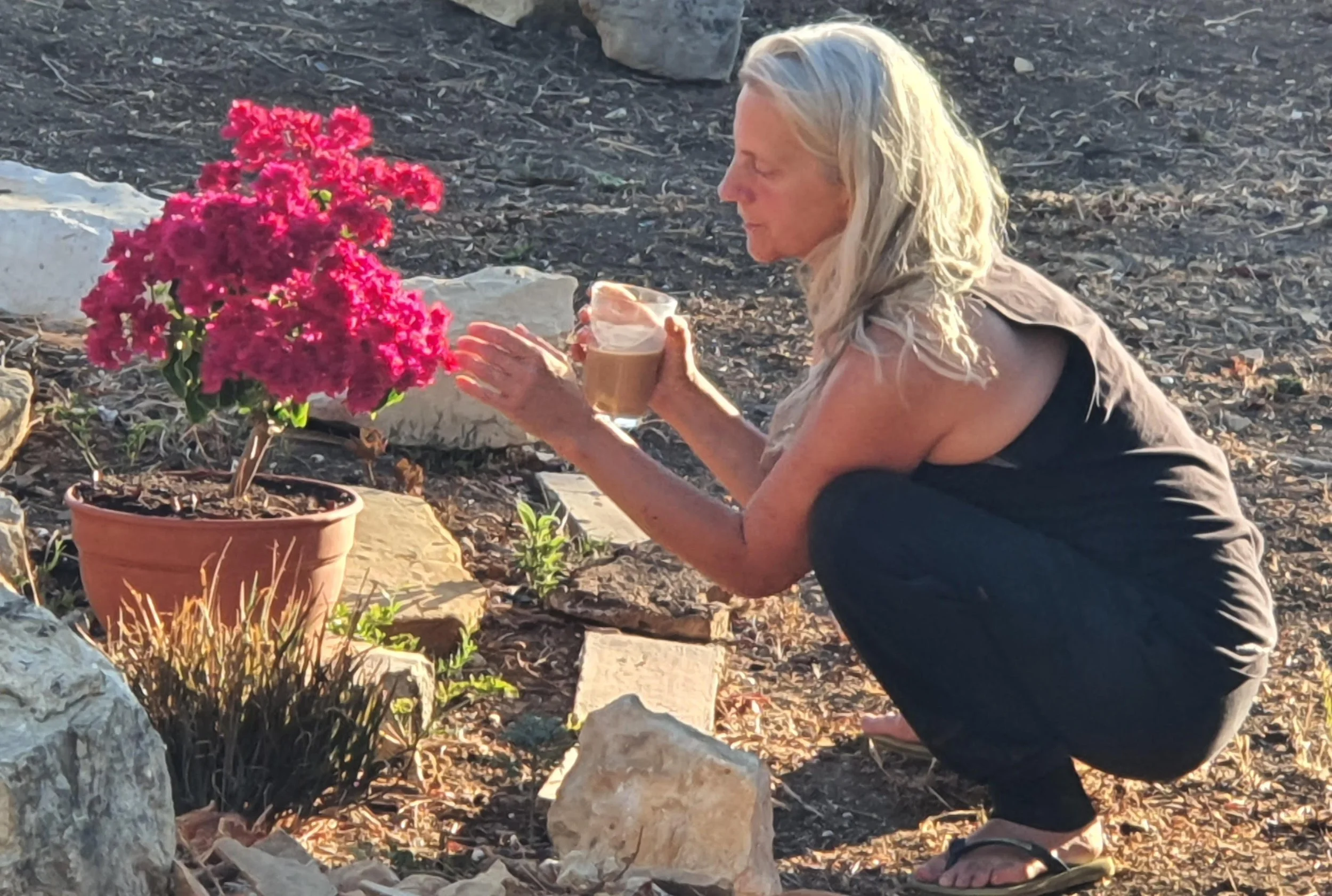
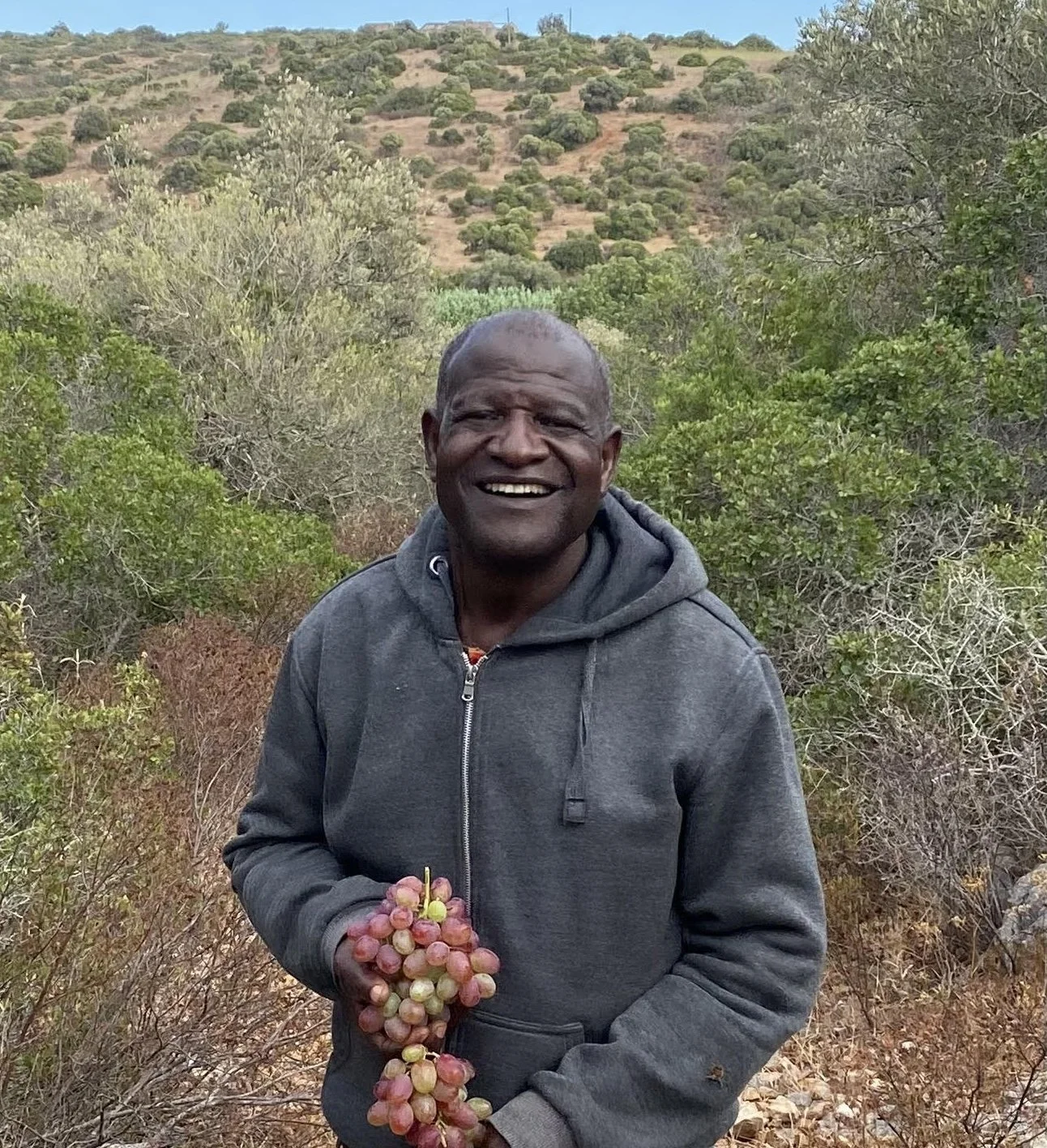
Heide and Konkankoh on site in Portugal
Finding home
In amongst the ruins they are regenerating – the ruins of land, displacement, colonization – Heide and Konkankoh have found a home together.
For Konkankoh:
“We’ve just been like a kind of prayer or dream together, trying to experiment with what it means to bring two worlds together.
I realised that somehow the little child, the one who makes Westerners tick or who they truly are, is the same child that makes me think I can, at some point, also allow my own child to come out and play.
If you mix these two colours together, what do you get? I think the thing we are doing together is a miracle. When I listen to Maria, it always reveals something about me”
For Heide:
“I hear a lot of wisdom speaking when I listen to Konkankoh. A lot of love. A lot of space. No judgment.
When I met Konkankoh, I told him that I am home. That he brought me home.”
And so, this is the story of the plant, as Konkankoh asked. Of the land. Of the coming together of different worlds. Of what regenerating really means.
It’s not just new planets that form. But new solar systems. New ways grown out of ancient ways. New homes grown from abandoned ones.
The spark that can be ignited when we allow ourselves to collide.
Konkankoh and Heide are calling for investors and goodwill organizations who share their mission to collaborate in exploring the vital role of regenerative community-led initiatives driving just, inclusive, and place-based sustainability transitions that connect Europe and Africa. To get in touch email geral@africanway.world.
Further reading:
The role of eldership in regenerative transformation Regenerators Blog
Co-creating an African Peace Village in Portugal Post Growth Institute
Colonial patterns within us Regenerators Blog