When Things Fall Apart, Leaders Must Build Resilience
I was recently on a work trip for a big multinational that is on a journey to make its company culture more regenerative; an impressive leadership and culture transformation, led internally and built on regenerative leadership principles.
It’s a remarkable transformation: the core team is traveling the world teaching ecosystem facilitation, seeing the organization as a living system woven together with nervous system understanding, somatic healing techniques, and practices to strengthen mental, spiritual, and physical health.
Sometimes I’m part of these gatherings to teach about regenerative leadership and how to become facilitators of living systems, and I always notice this behavioural pattern.
In a couple of days they go through a process of:
Does this really have relevance for my job and our business (insert faces of disbelief during the morning ice bath or yoga session).
Arms crossed and distant facial expressions in the first half an hour or morning practice.
Then something shifts.
Their body language changes from closed to receptive. They begin listening. They start to scribble ideas down and lean in.
They get it.
And this is not a pattern I’ve only noticed within this organization. It repeats again and again: from “this is some hyped, hippy, hug-a-tree, wellness bullshit” to “this makes so much sense, it’s directly related to resilience.”
Resilience. Adaptability. Trust. Collective wisdom. Evolution. These qualities shift the energy of organizational landscapes. People begin to understand that a regenerative approach – an approach centered around life – is not a nice-to-have, but something that helps them navigate more smoothly through this crazy time.
Because we are living through a moment many leaders intuitively recognize as unprecedented, even if we lack the language to fully articulate it. Across the world, social, political, economic, and ecological systems are being shaken simultaneously. Wars have returned to the center of geopolitical reality. Democratic institutions feel increasingly fragile. Trust is eroding, both within societies and between nations. Artificial intelligence is advancing at a pace that far outstrips our cultural, ethical, and regulatory capacity to integrate it wisely. Supply chains remain brittle. Economies unstable. Polarization deepens almost everywhere we look. Employee turnover, apathy, and disengagement are at an all-time high.
In response, leadership attention is narrowing. Contracting.
In boardrooms, ministries, and executive teams, the focus gravitates toward rearmament, competitiveness, technological advantage, risk mitigation, and control. These concerns are not irrational; they are understandable reactions to uncertainty. And yet, something essential is missing from the dominant leadership narrative, and it causes me great concern.
While our collective gaze is fixed on geopolitical instability, AI acceleration, and economic risk, we are in danger of losing sight of a far deeper and more consequential crisis: the progressive breakdown of the life-sustaining systems upon which all human activity depends.
Climate instability. Biodiversity collapse. Soil degradation. Water scarcity. The destabilization of ecosystems. These are no longer distant warnings; they are present realities.
At the same time, human nervous systems – individual and collective – are showing clear signs of massive strain. Burnout, anxiety, depression, disengagement, and a pervasive sense of overwhelm have become normalized features of organizational life.
These two crises are not separate. They are expressions of the same underlying worldview. We cannot navigate through our current reality in a state of fight or flight. It is utterly unwise and dangerous.
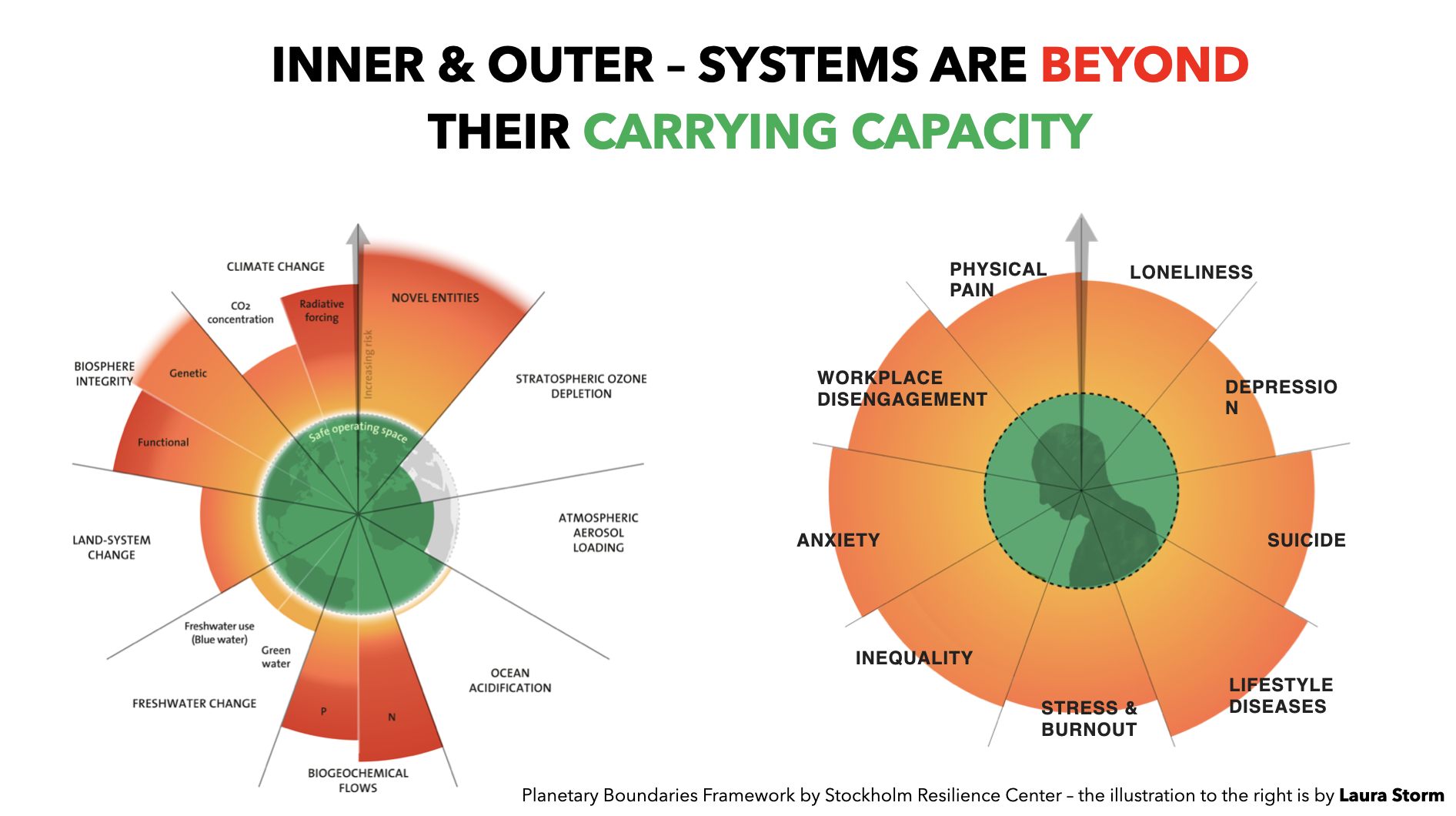
Illustration by Laura Storm, Regenerators
We have outgrown the machine-mentality
At its core, the dominant organizational paradigm still treats the world as a machine and humans as components within it. Organizations are designed as hierarchies optimized for efficiency, control, predictability, and extraction. Nature is treated as a resource. People are treated as inputs to make as efficient and productive as possible.This mechanistic worldview may have delivered short-term growth and stability in the past, but it is fundamentally misaligned with the reality we now inhabit.
Mechanistic hierarchies can perform well under stable and predictable conditions. However in a world defined by volatility, uncertainty, complexity, and cascading crises, machine-like organizations may appear strong on the surface – and the natural default for many right now – yet they are internally fragile. And fragility, in times of systemic shock, is a liability we can no longer afford.
Resilience has become one of the most frequently invoked words in leadership discourse, yet it is often poorly understood. Too often, resilience is framed as toughness, endurance, or the capacity to push through adversity. In organizational settings, this misunderstanding translates into calls for greater efficiency, faster decision-making, and higher performance under pressure. Work longer hours and push through. But this version of resilience has nothing to do with resilience – it’s institutionalized survival mode that will lead to collapse.
What we can learn from 3.8 billion years of evolutionary wisdom
In living systems, resilience does not emerge from force or control. It emerges from health and evolution, when relationships and collaboration are strong. A resilient forest is not one that resists all disturbance; it is one that can absorb shock, reorganize, collaborate, share resources, and continue to evolve without losing its essential integrity and sense of purpose. Diversity, strong relationships, feedback loops, and periods of rest are not inefficiencies in such systems, they are what makes the system strong, resilient and efficient.
The same is true for human systems.
Organizations are not abstract entities. They are composed of human beings with nervous systems that continuously register safety or threat, connection or isolation, fear or trust. This is not something we can shut off; it is part of our design, shaped by 500,000 generations of Homo sapiens evolution. It is the reason we have survived as a fairly fragile species.
And when our nervous system is operating in overwhelm, we know from research that we cannot access our creative problem-solving skills, our capacity to think in interconnected systems, or our ability to collaborate – all essential skills for this time.
Every organization has a collective nervous system, shaped by the state of the individual nervous systems coming together, and further shaped by leadership behavior, cultural norms, communication patterns, decision-making processes, and the unspoken emotional tone of everyday interactions. Whether acknowledged or not, this collective nervous system profoundly influences how an organization responds to uncertainty.
Hierarchical, fear-based organizations operate from chronically activated nervous systems. Under pressure, they default to control, speed, compliance, and self-protective behaviour. Cultural toxicity increases. From the perspective of neuroscience, such systems are dominated by fight-or-flight responses. While this may produce short bursts of activity, it significantly reduces an organization’s capacity for nuanced thinking, systems thinking, creativity, innovation, resilience, commitment, and the ability to evolve and dance flexibly in a landscape of change.
Stressed nervous systems narrow perception. They reduce tolerance for ambiguity and difference. They prioritize short-term survival over long-term viability. In moments of crisis, they freeze or react impulsively, often reinforcing the very patterns that created vulnerability in the first place. This is why organizations under pressure so often centralize power, silence dissent, and oversimplify complex realities into false binaries. What looks like decisive leadership is, in many cases, a loss of systemic intelligence.
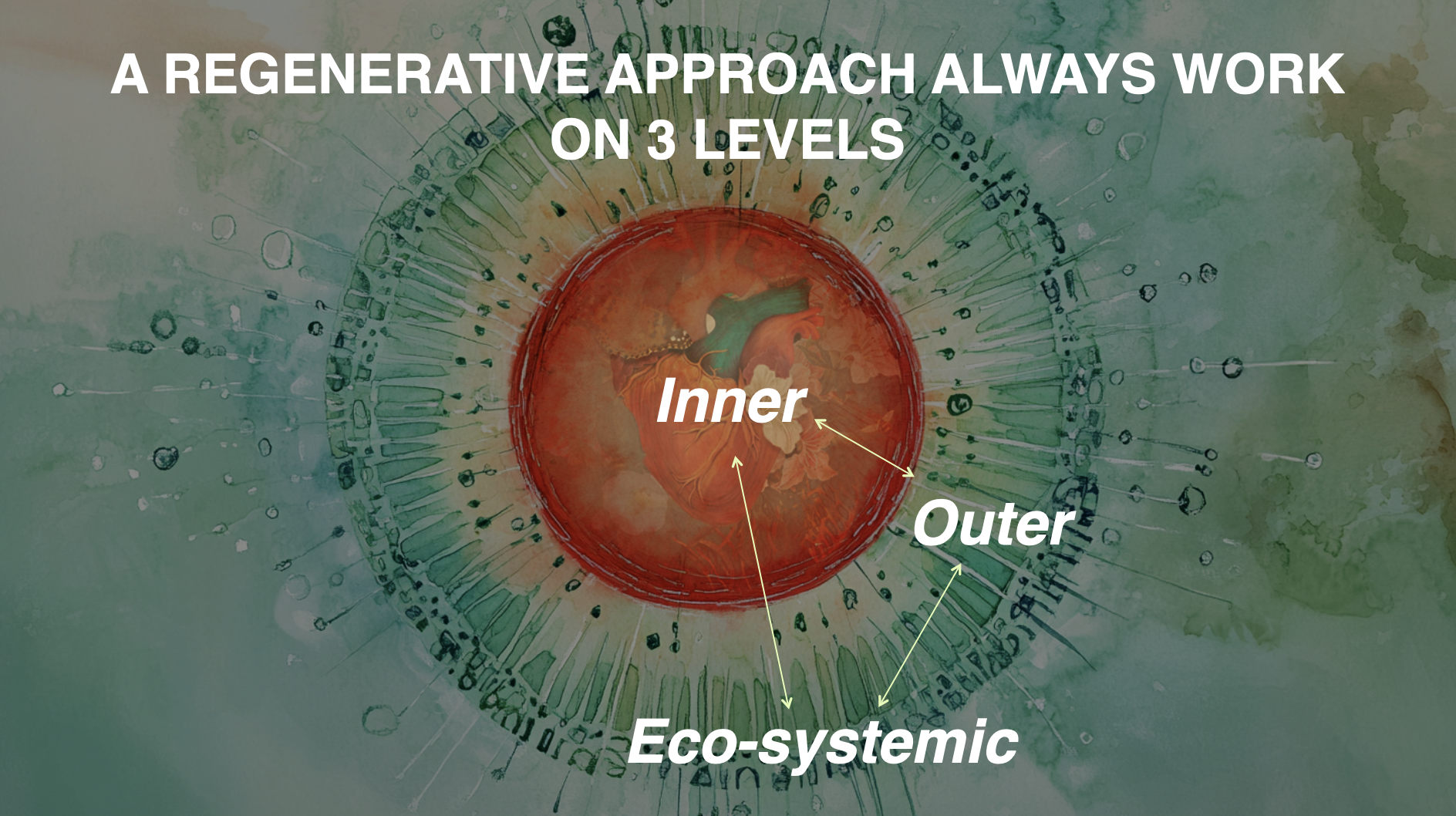
Credit: Laura Storm and Regenerators
The state of your nervous system directly influences your leadership
Understanding how nervous systems function (I often weave in the polyvagal theory by Stephen Porges in my work) has profound implications for how we understand leadership today. The challenges we face cannot be solved through better control or more sophisticated prediction. They require the capacity to sense, to listen, to hold complexity, and to respond adaptively as conditions change.
None of this is possible when leaders themselves are operating from chronically dysregulated nervous systems. And none of this can be done by AI.
Stressed bodies do not think clearly. They do not make wise decisions. They do not see the whole. They cannot think in interconnected systems. They become irrational, fear-based, self-protective, and short-sighted.
Understanding our nervous systems deeply is therefore essential for leaders today—for all of us. This is why it is a central thread in our learning journeys.
Most leadership development still treats the inner state of leaders as a hygiene issue rather than as foundational infrastructure. Or it is boxed into the HR department under the label “wellbeing,” something to be unpacked when there is time. Emotional regulation, relational capacity, and nervous-system literacy are often dismissed as “soft” skills, despite the fact that they directly shape organizational outcomes.
In reality, leaders are among the most powerful regulators in any system. Their presence, tone, and way of relating ripple outward, shaping collective behavior in ways no strategy document ever could.
Planetary fragility and human fragility
At the same time, we must confront the fact that organizational fragility mirrors planetary fragility. The same extractive logic that depletes human nervous systems also depletes ecosystems. The same worldview that prioritizes short-term gain over long-term health drives both burnout and ecological collapse.
These are not parallel problems. They are deeply intertwined expressions of a system that has lost its relationship with life.
A species—us, Homo sapiens—that has lost its way.
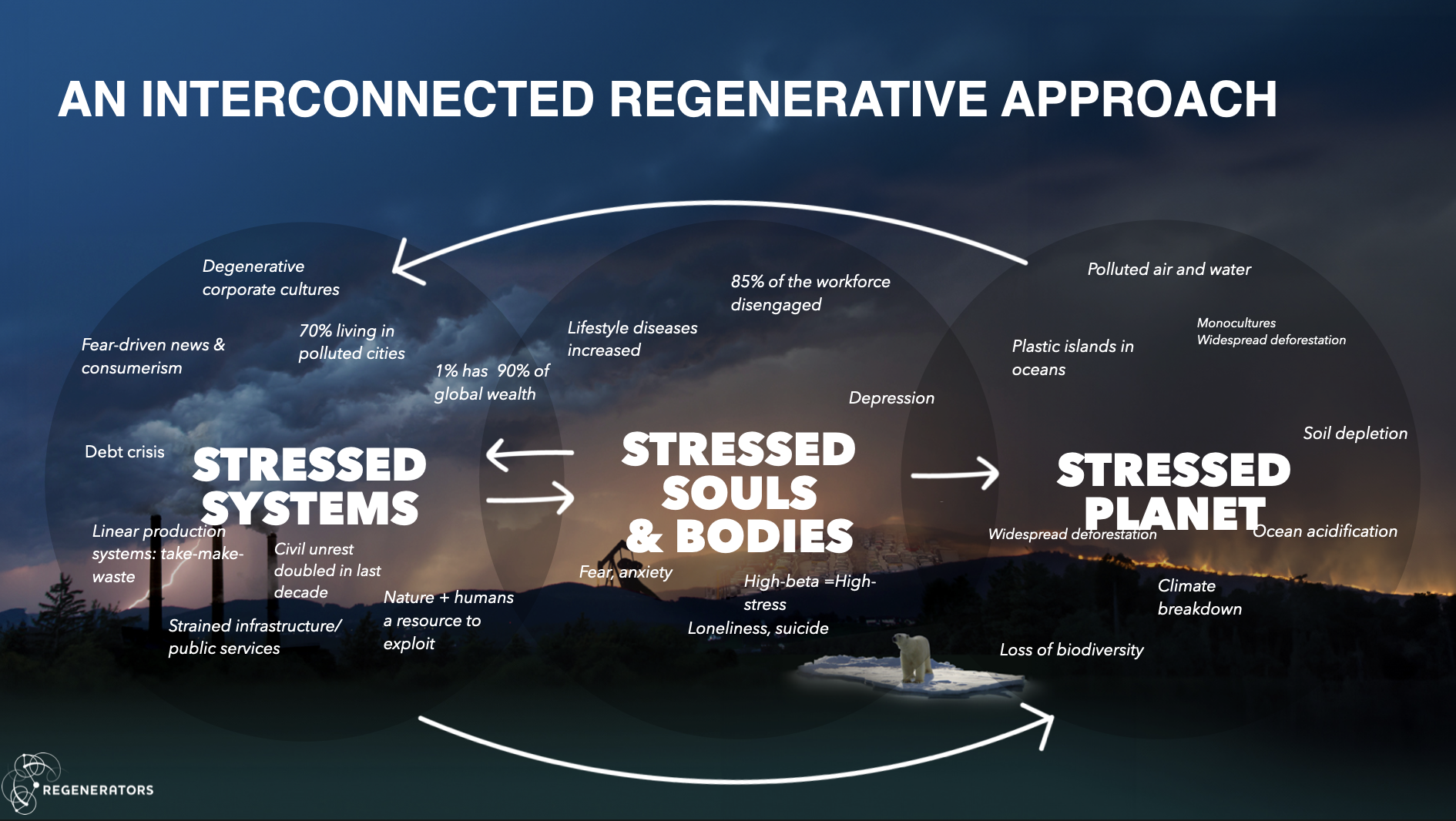
Credit: Laura Storm, Regenerators
I use this visual in my courses and learning journeys to frame the interconnectedness of our challenges and to stress that the regenerative leader is one who sees this connection: who understands that the health of their nervous system directly affects the overall health of their organization, and that any system operating in the red danger zone is a system moving toward collapse - whether it is our bodies or our planetary life-supporting ecosystems.
Seeing organizations as living systems
So what does it mean to see your organization as a living system?
The real work right now is to redesign our organizations, economies, and institutions so they align with how living systems build resilience, innovate, and evolve. Living systems are the only systems that have truly stood the test of time. It is time we learn from their deeper wisdom.
Thinking of organizations as living systems is not a metaphorical hippie exercise romanticizing nature (a misunderstanding I encounter often). It is a shift in ontological orientation—a shift in worldview (and, dare I say, a shift in level of consciousness).
It requires us to recognize that organizations are networks of relationships rather than static structures; that value and innovation emerge through interaction and cross-pollination; and that intelligence and wisdom are distributed throughout the system rather than concentrated at the top.
It invites us to move from linear planning toward continuous sensing and responding, from command-and-control toward stewardship and facilitation.
Culture is the soil
In living systems, culture is not an accessory. It is the soil. The foundation for all life. It determines what can grow, what withers, and what becomes possible over time.
Cultural soil is shaped by what is rewarded and punished, by how mistakes are treated, by whether people feel safe to speak honestly, and by whether the system acknowledges that humans are cyclical beings and therefore need cyclical cultures to thrive. Cultures that prioritize pause, rest, reflection, and integration.
In depleted soil, even the most talented individuals struggle to thrive. In toxic cultures, innovation dries up, trust erodes, and resilience collapses. Healthy organizational cultures are not conflict-free or endlessly harmonious. I have helped organizations hold space for regenerative journeys for over a decade now. It is not easy work, but it is endlessly rewarding.
Regenerative organizations are robust enough to hold tension, difference, and uncertainty without fragmenting. They allow for grief, not-knowing, and honest reflection, recognizing these not as weaknesses but as sources of collective wisdom. Such cultures are not built through slogans or values statements. They are cultivated through consistent leadership behaviour and relational integrity.
Relationships are the real architecture
This brings me to one of the most overlooked truths of organizational resilience: relationships are the real architecture. They are the difference between life and death. Health or dysfunction.
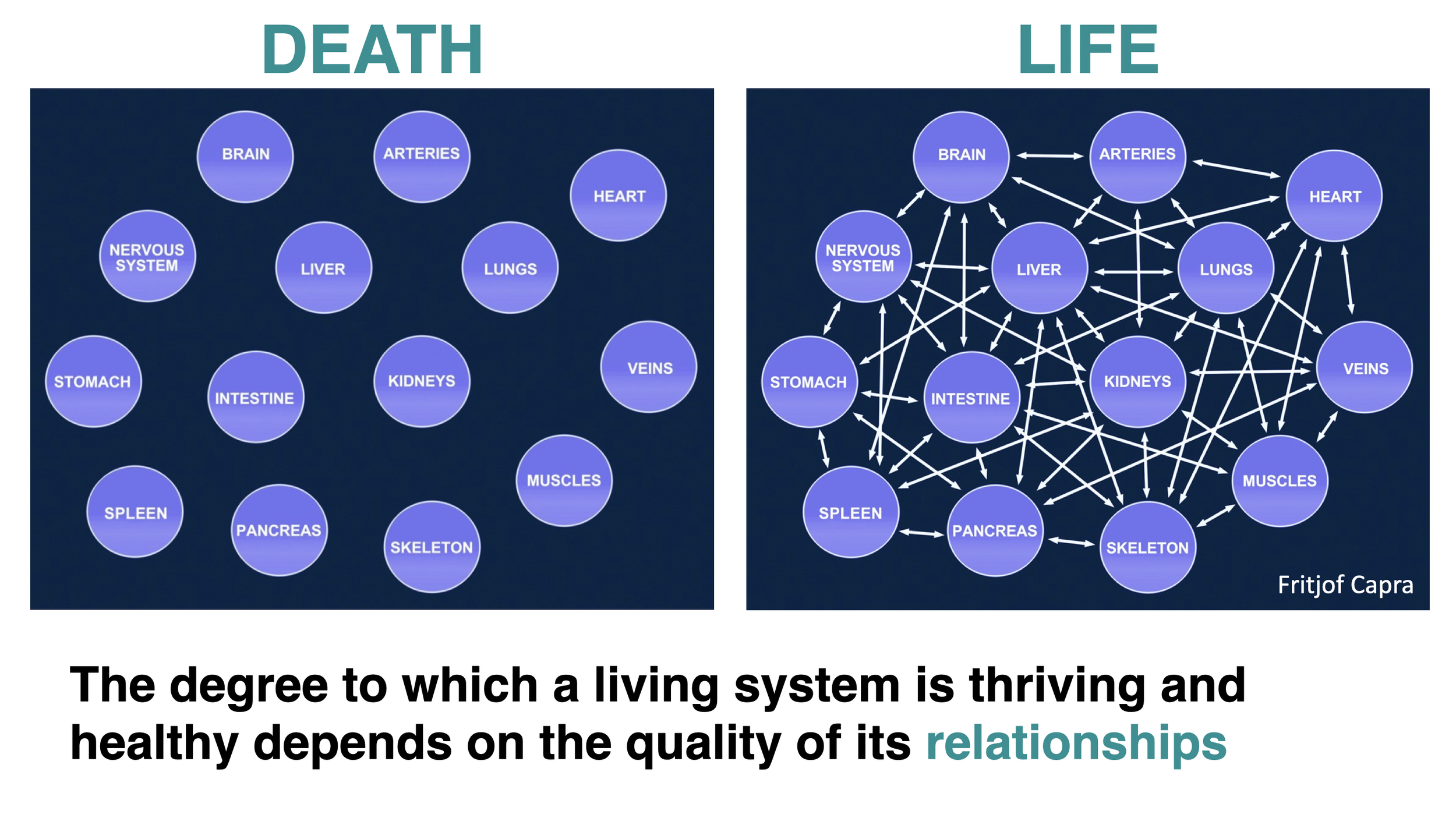
Image credit: Fritjof Capra
In times of disruption, leaders often respond by reorganizing structures, introducing new processes, or tightening controls. While structure matters, it is relationships that determine whether a system can adapt without breaking.
Trust, mutual understanding, care, respect and relational depth enable faster learning, more effective coordination, and greater capacity to respond creatively under pressure.
Flexible and agile organizations are not those that change direction most frequently, but those that have invested deeply in relational capacity over time. They have learned to slow down enough to listen, to decentralize authority where appropriate, and to trust local intelligence. They understand that coherence emerges not from uniformity, but from alignment around shared purpose and care for the whole.
This perspective fundamentally reframes the role of leadership. The leader is no longer the heroic decision-maker who possesses all the answers, but the steward of conditions. Leadership becomes less about control and more about cultivating conditions, coherence, sense-making, and regenerative capacity within the system.
It involves paying attention to what the system is signaling, amplifying life-giving patterns, and addressing sources of depletion before they become points of collapse.
As Jos de Blok, who will join us again this year as a guest teacher at the Regenerators Academy to share his experience from Buurtzorg, says:
“My main responsibility is to listen deeply to the people and the landscape”.
We always practice listening deeply in our courses and I always try and weave in a deep listening practice in my keynotes. It’s an essential skill for us all in a time like ours.
A dangerous illusion
There is a persistent illusion that once geopolitical tensions settle, once markets stabilize, once technological transitions are complete, we will finally have the space to focus on wellbeing, culture, and ecological responsibility.
This illusion dangerous, it genuinely scares me.
We are on a fast track towards planetary collapse. Volatility is not a temporary phase; it is the new baseline. Regenerative approaches are what allows us to move through volatility without destroying the very systems all life depends on.
Regenerative leadership asks different questions.
Does this decision increase or diminish the capacity for life over time?
Is this organization building resilience—or quietly eroding it?
Are we restoring the social and ecological systems that sustain us, or continuing to draw down their capital in the name of short-term success?
These questions are not ideological. They are existential and deeply urgent.
The future will not belong to the fastest, the most aggressive, or the most technologically advanced organizations. It will belong to those with the healthiest systems; systems capable of learning, adapting, and regenerating in the face of ongoing disruption.
Organizations that continue to behave like machines in a living world will struggle, no matter how sophisticated their tools or strategies. Those that learn to live; to relate, to sense, and to regenerate will be far better equipped to navigate what lies ahead.
If we are serious about resilience, about navigating uncertainty with wisdom rather than fear, and about leaving viable systems for those who come after us, then learning to think and lead as part of living systems is no longer optional.
It is the work of our time.
Join our 5-week Regenerative Resilience Course from May 20 - June 19.