"You are welcome": going deeper into regeneration with Nigeria
Notes on South-North collaboration and decolonial practices from the first Regenerators gathering in West Africa
There are trips you go to for visiting someone or some place. Others you go to because you need an escape and fresh experiences. And others that you don't know exactly why, but your gut keeps telling you 'go'.
Attending the first Regenerators gathering in West Africa in April 2026 fit the last category.
This is the story of a one week trip that took almost two years in the making. A gathering that activated regenerative ripples across continents and people from very different lands. An experience that moved through layers of beliefs, biases, raw realities, colonial patterns, and systems of separation to reach what we share underneath.
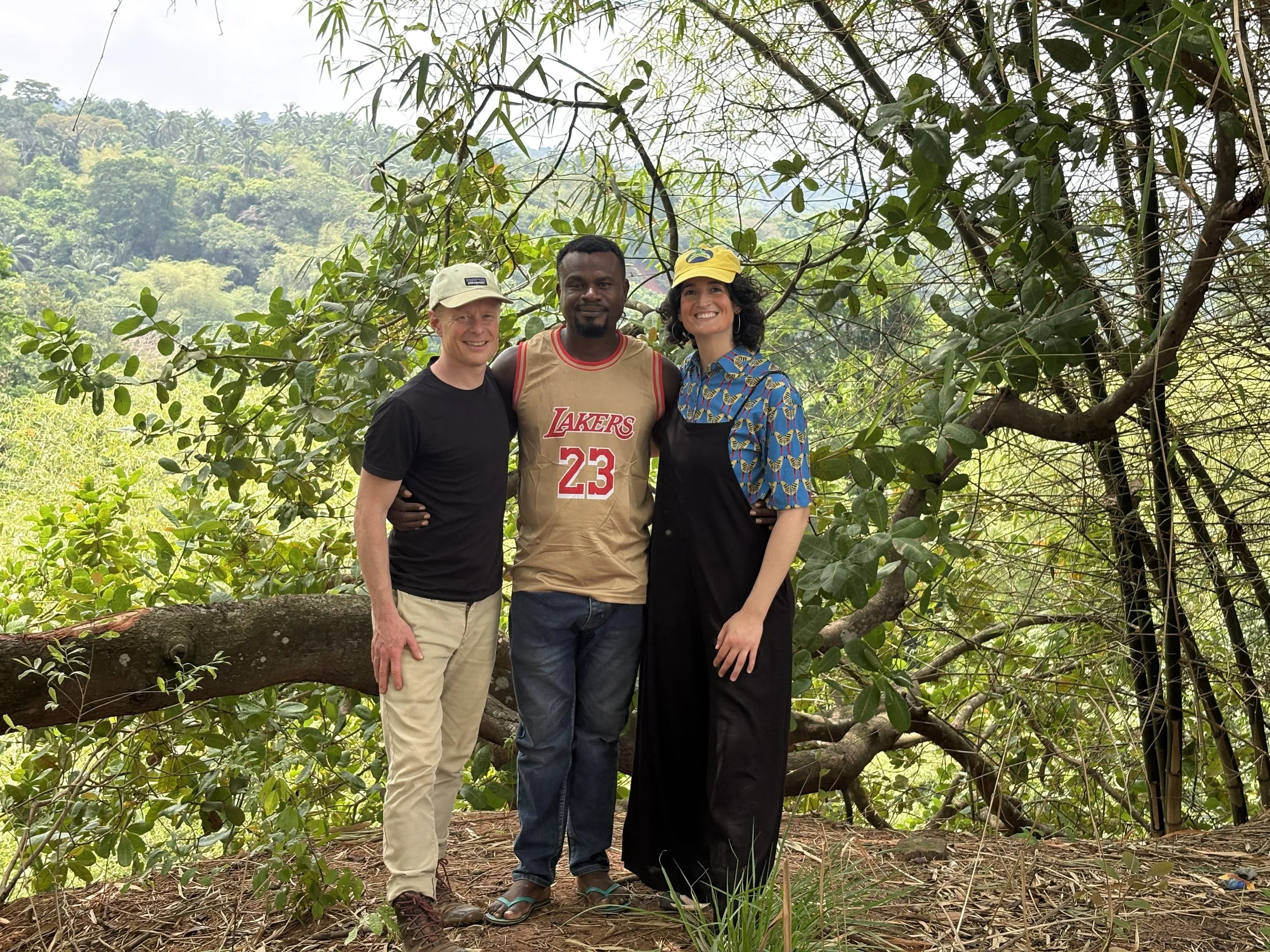
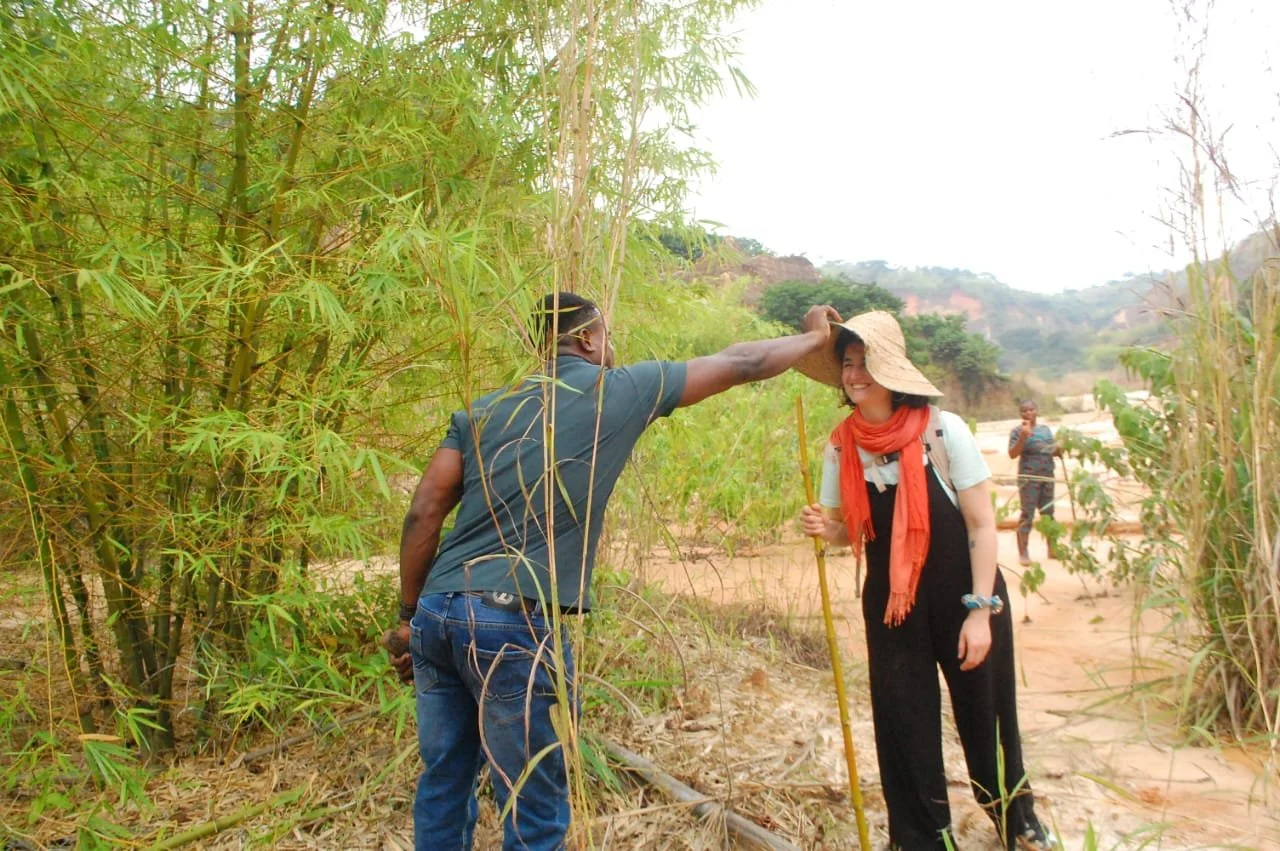
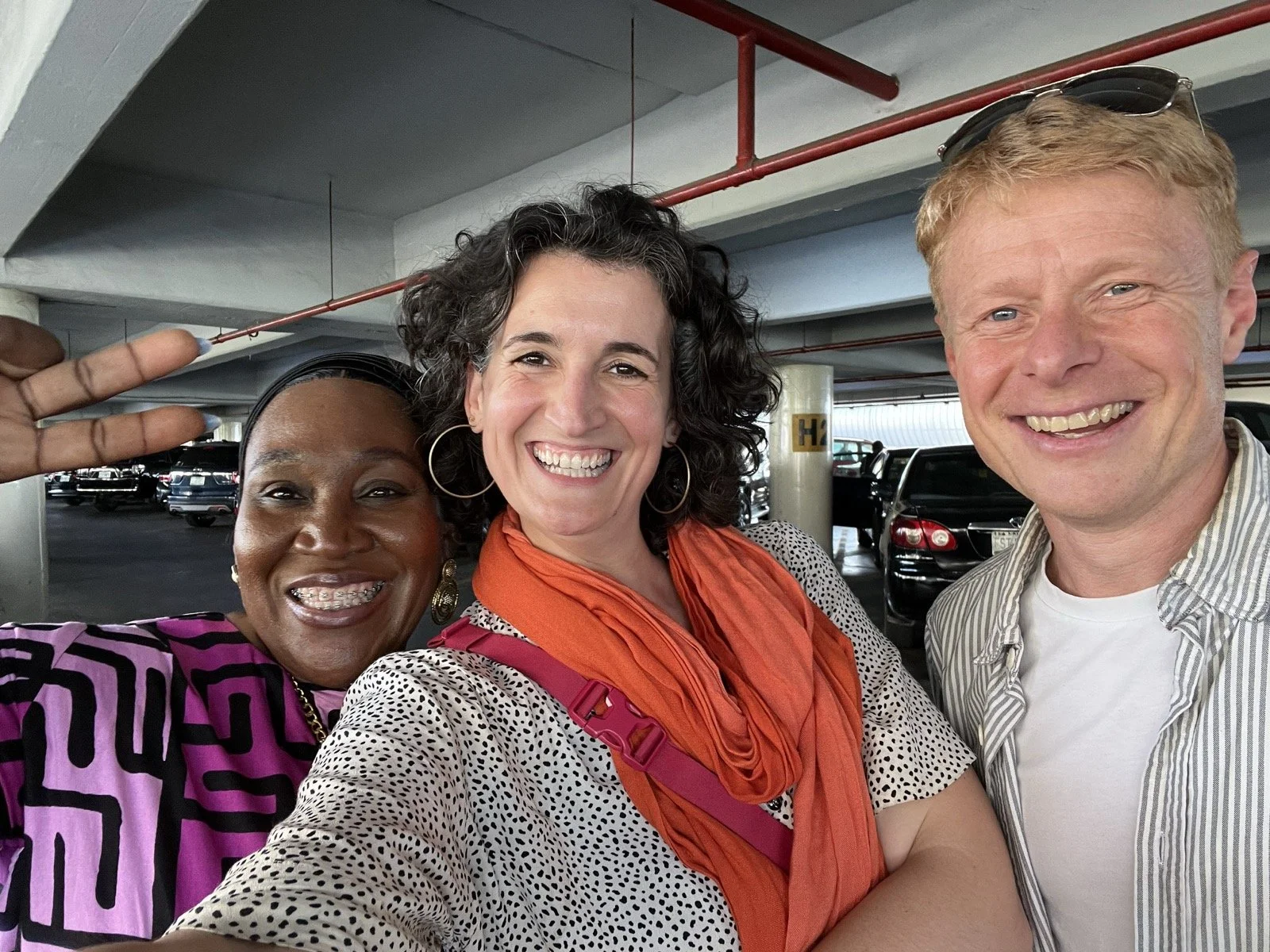
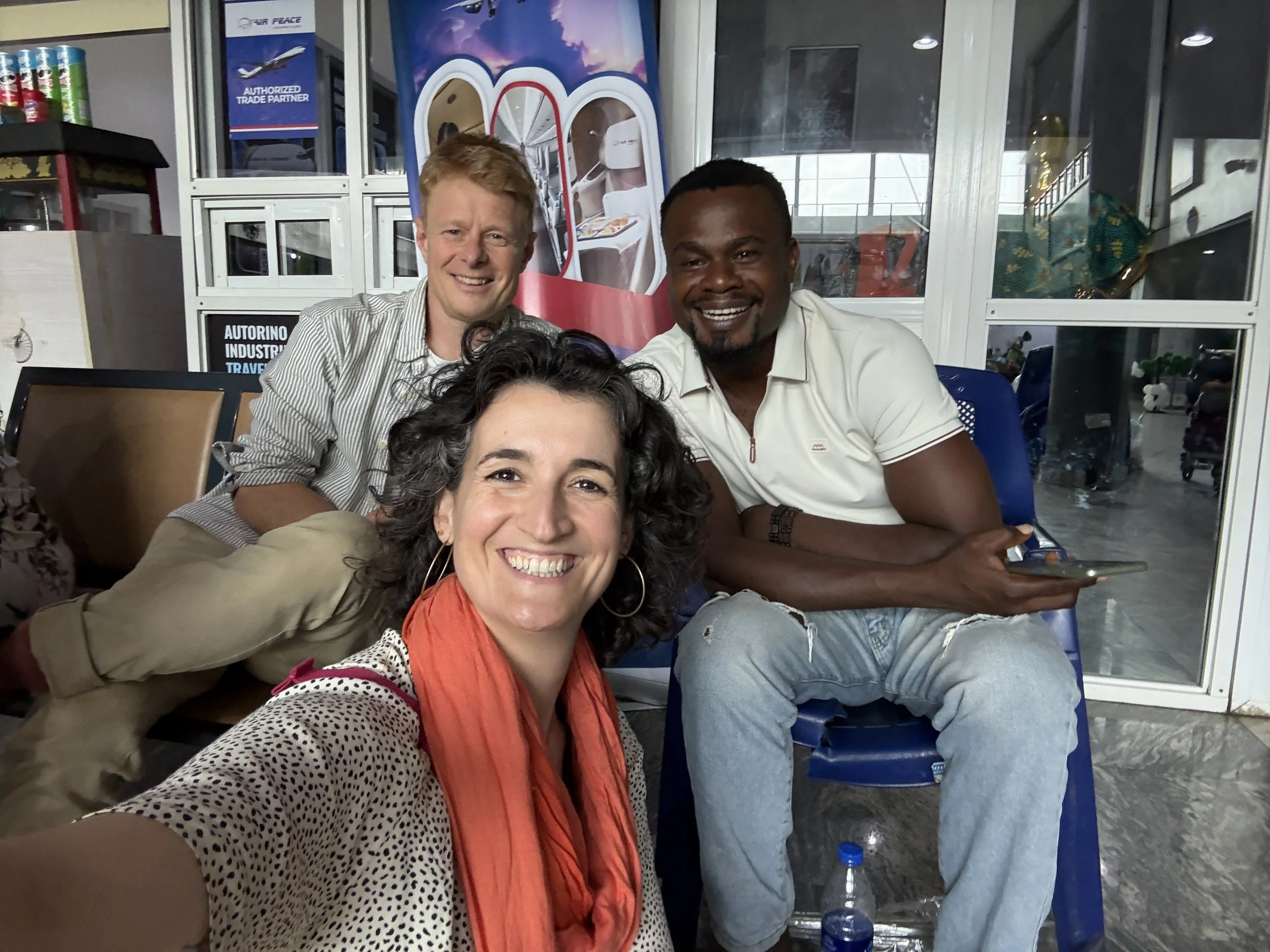
From left to right: Neil Adams, Emmanuel Izuegbunam, and Judit Saez Gonzalvez in the forests near Oko Town, southeast Nigeria, in April 2026.
Before we start
What you will read is narrated with my own lens as a white Spanish cisgender woman living in Germany who was invited to travel to Nigeria and Africa for the first time in her life.
Far from wanting to romanticise this experience, all I explain here is true to what my mind and body went through. If you read passages that feel fluffy and spiritual, it’s because I lived them like so. If you read passages that feel tough and alarming, it’s because I lived them like so. If you read passages that make you think “Oh, white people problems…”, it’s because I’m indeed white and these are the challenges I hold as a white regenerative practitioner.
There is a reason why Nigeria called me and I said yes. It is my intention and hope that what looked like two white European people visiting a village in southeast Nigeria for a few days turns into a seed of regeneration for genuine and caring South-North collaboration. Getting our hands dirty with the complexities and pain of worlds torn apart, recognising the beauty that emerges when what we share and what makes us different unite us, carrying the work of the many before us who nurtured systemic change through decolonial practices.
At the end of the piece, you will find three “souvenirs” I brought with me from Nigeria: three wicked questions. Predicaments that clearly came to the surface while I was there and that I keep carrying with me, that emerged from within when the wonderful peoples and lands of Nigeria and Africa cracked my heart open. Complex, uncomfortable questions along my personal journey on decolonisation I can’t turn my back on. And that, maybe, if you read them, will also stay with you.
Who gets to be in the room
Since the inception of Regenerators and the first Regenerative Leadership Journey programs, the community of alumni and participants have been self-organising physical gatherings. Spaces for these change activators to come together beyond the screen, practice regenerative principles, and keep on exploring how to live, lead, and design for life.
From big gatherings to more intimate circles like some in the Netherlands or France, we all feel deeply grateful for digital platforms that allow us to connect across regions and timezones, and agree that gathering physically elevates connection to a new level. Gathering physically, though, requires jumping through some hoops: logistical, financial, political and mental barriers that become evident when the chosen location reveals whose mobility the system was built for, and whose wasn't.
This is what happened in 2024, when the second Regenerators Alumni Gathering in Selgars, UK, took place. As a 2023 alumna who had recently joined the Regenerators team as Community Nurturer, I travelled across Europe by train to reach the South West of England in August. My Spanish passport allows me to move freely within the European Union, and jump to the UK filling in the electronic travel authorisation and paying 20 pounds. Many others traveled from within the UK, other European countries, and the US.
And one person didn't make it: Emmanuel Izuegbunam, born and living in Nigeria, founder of Akaama Peoples Empowerment Foundation, dedicated to regenerative education and land restoration in his hometown Oko (southeast Nigeria). Emmanuel was at that time participating in the Regenerative Leadership Journey with a granted scholarship. He had the intention of joining the gathering and Neil Adams, co-traveler of the Journey, born and residing in the UK, supported Emmanuel by writing a letter of invitation for his visa application process.
Emmanuel's visa was denied.
He sent a video message expressing how much he would have liked to be there with us. We held a conversation to sit with Emmanuel's absence, and widened it to hold the many others who couldn't be there. The collective challenge became clear:
“How do we deepen necessary regenerative relationships South-North when the very systems we’re trying to change keep deciding who gets to be in the room?”
As you can imagine, we didn't get to a solution and the dialogues we had over those days surfaced tensions, friction, and disagreement. Both logical and necessary. Our little circle just became a mirror of what’s happening in our societies when we address one of the most complex challenges we currently hold: decolonisation.
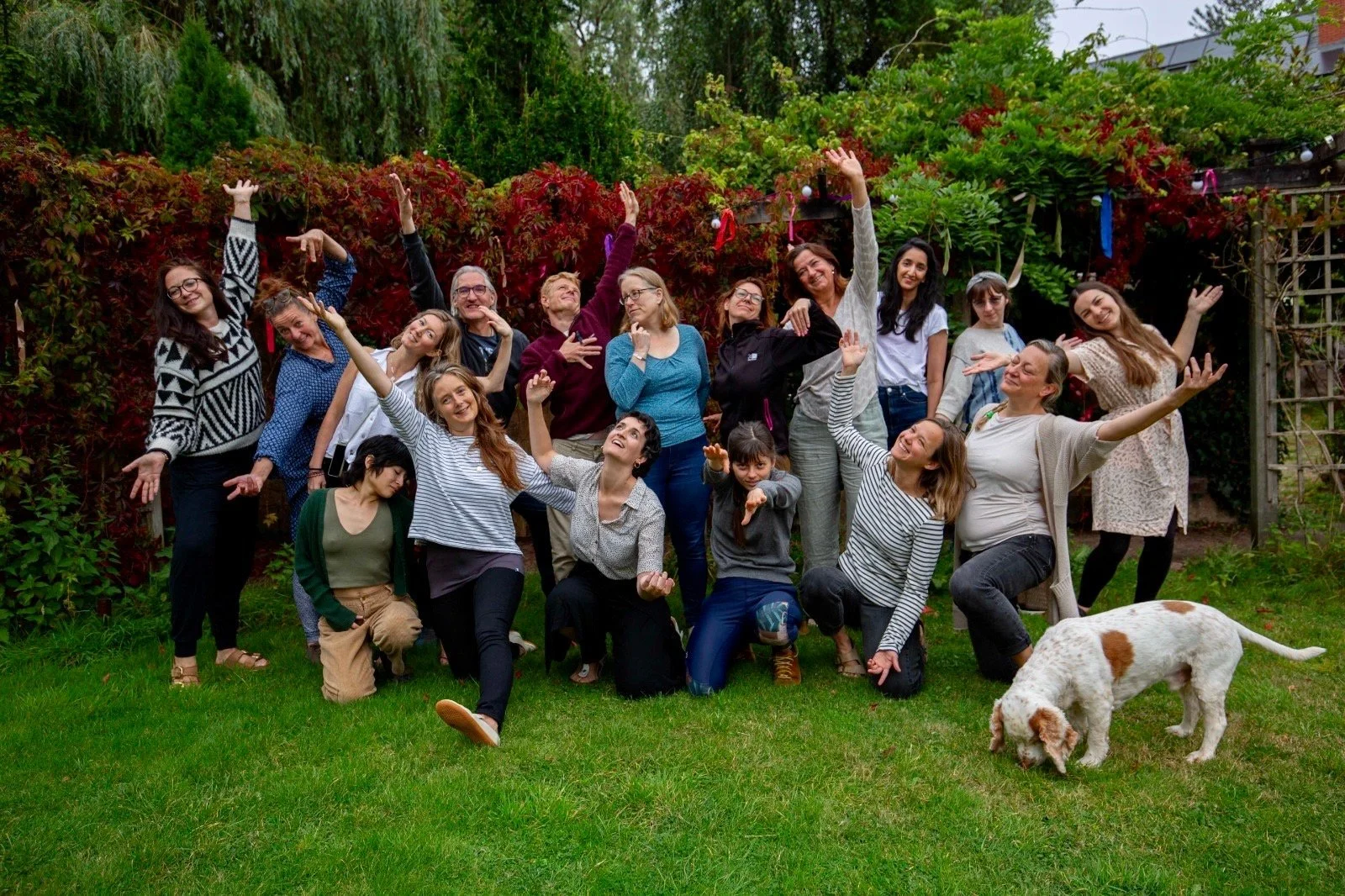
Participants of the Regenerators Alumni Gathering in Selgars, UK, August 2024.
If the mountain won't come…
I can say for myself that I left the UK with much love for this community, and a heavy heart for the injustice we had experienced. Neil and Emmanuel felt it too, and some time after they had a chat with Regenerators' founder Laura Storm to keep the conversation going. Those involved in regeneration and systems change have made a commitment to not letting tensions just pass by. We see the tensions not as something to be avoided, but as a sign that there's something there that requires our attention.
And so the seed planted in the UK sprouted into a question: Why not a physical gathering in Nigeria?
In the very style of “if Mohammed doesn't go to the mountain, the mountain goes to Mohammed” we made an open call to the wider Regenerators community and gathered the contacts of those interested in participating in the emergence of the first Regenerators gathering in West Africa. Emmanuel suggested 7-12 April 2026, during the planting season, so that we could learn more about the erosion affecting their region and directly contribute to their efforts of land restoration and community awareness. We had one year to make it happen.
Are you really going to do this?
Disclaimer: What I explain in the next chapter responds to my intention to illustrate the decision making process that we all had to go through, the mental barriers we had to deal with, before booking flights. It's not my intention to create a framing for you to position the people who decided to travel for this gathering in any kind of heroic status. Neither to dilute nor sweeten the realities the Nigerian people face everyday.
Organizing a gathering like this goes beyond the basic to-do list of finding accommodation and booking flights. Security and trust building climbed to the top of the list. Nigeria faces deep economic strain, political fragility, and religious-driven violence. These are not random misfortunes but the long tail of colonial extraction, artificial borders, imposed systems of governance, and foreign religions that were never designed for the people living within them. As of April 2026, the north of the country has a range of active conflicts mainly caused by the Boko Haram insurgency, the operations of ISWAP (Islamic State West Africa Province) and militant activity in the Niger Delta. Any Foreign Affairs ministry in the Global North wouldn't recommend travelling to Nigeria unless strictly necessary, or under no circumstances. This said, the hermetic access to reliable sources of information and the inclination of northern and western media to flatten African countries into a single narrative of crisis wasn't going to give us the full picture of the real situation on the ground.
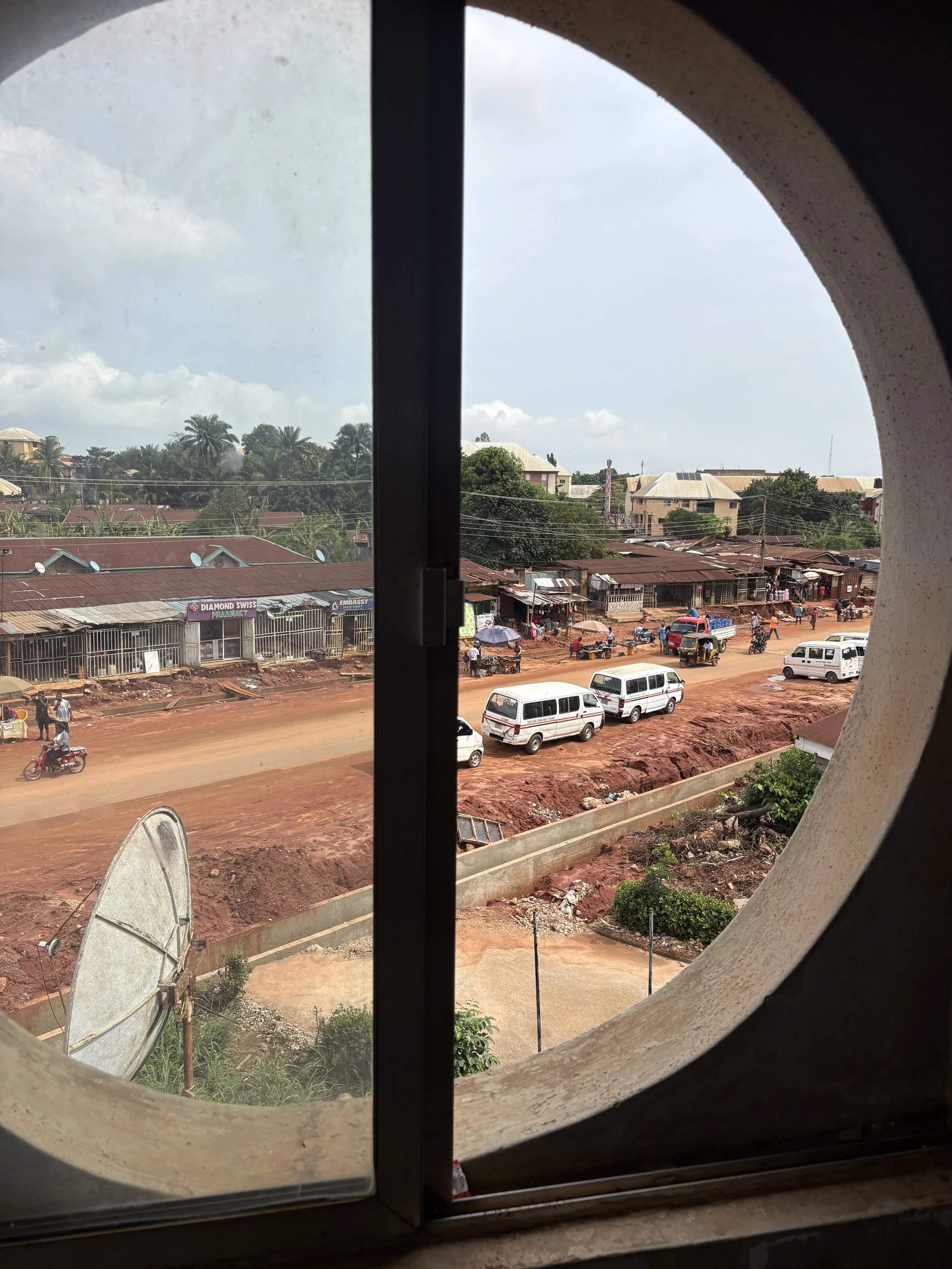
The Regenerators West Africa gathering happened in Oko Town, Orumba North, in the state of Anambra, southeast Nigeria. Security diligence was required, and Emmanuel made sure the local political and community leaders were aware of our plans and granted their invitations to receive the Regenerators community guests.
This wasn't just to guarantee their blessings in the activities we were going to perform, but also to assess the impact of having a group of white people walking around in an area where peace depends on a big collective effort to maintain safe roads and harmonious daily life with security agencies. Extending an invitation to a group of Northerners to come to a place where white people are not usual implies a big responsibility for the hosts, both for the security of these individuals and for the security of their community.
Adeola Khago, based in Lagos, also part of the alumni community and co-organizer of the gathering, kindly requested a security report focused in Oko, for those travelling to understand the situation better. I had to assess the risk of putting myself through this, not just because of the impact my white body could have in the southeast of Nigeria, but also of the impact that embarking on this trip would have on the relationship with my partner, family, collaborators, and close friends. The root of this gathering was to actively do something about the unequal South-North systems in place that keep us apart, and while that stayed true throughout, going through the security report with bullet points like 'Cult related violence & reprisals attack', 'Kidnapping, abductions & ransom demands' or 'Violent armed robbery' was a deep shock to my nervous system and sense of survival. I won't lie: I got scared and considered cancelling my participation.
End of January 2026 and the question started to burn: Are you really going to do this?
Some of those in the Regenerators community who had expressed interest in participating had already communicated that they were not able to join because of financial and family challenges. And at this point some others decided not to join as the risk of a trip like this weighed more than the noble intentions behind the gathering. I'd like to express here my love and support for those who made these decisions, as I know that it wasn't easy and they carried the sorrow of not joining the gathering they wholeheartedly supported.
Last call for all passengers
The list of participants went down to three of us: Adeola, Neil, and I. Neil and I being the only two who would travel from Europe, departing from the UK and Germany respectively. Adeola finally couldn’t make it to Oko, and Neil and I were lucky enough to be with her and enjoy for a few hours the hospitality of her home and family in Lagos.
I recall how I felt a new sense of responsibility and respect for this whole trip. In Regenerators, we explore the Story of Separation as the root cause of what brought us to the current situations we're facing in the modern world. Decolonisation is at the very core of the regenerative practice and the advancement of life-affirming systems in our societies. Never before had I experienced so strongly the colonial structures still in place as in this moment: a massive net of opaque information, biases and beliefs built with the efforts of generations to scale and maintain systems of separation.
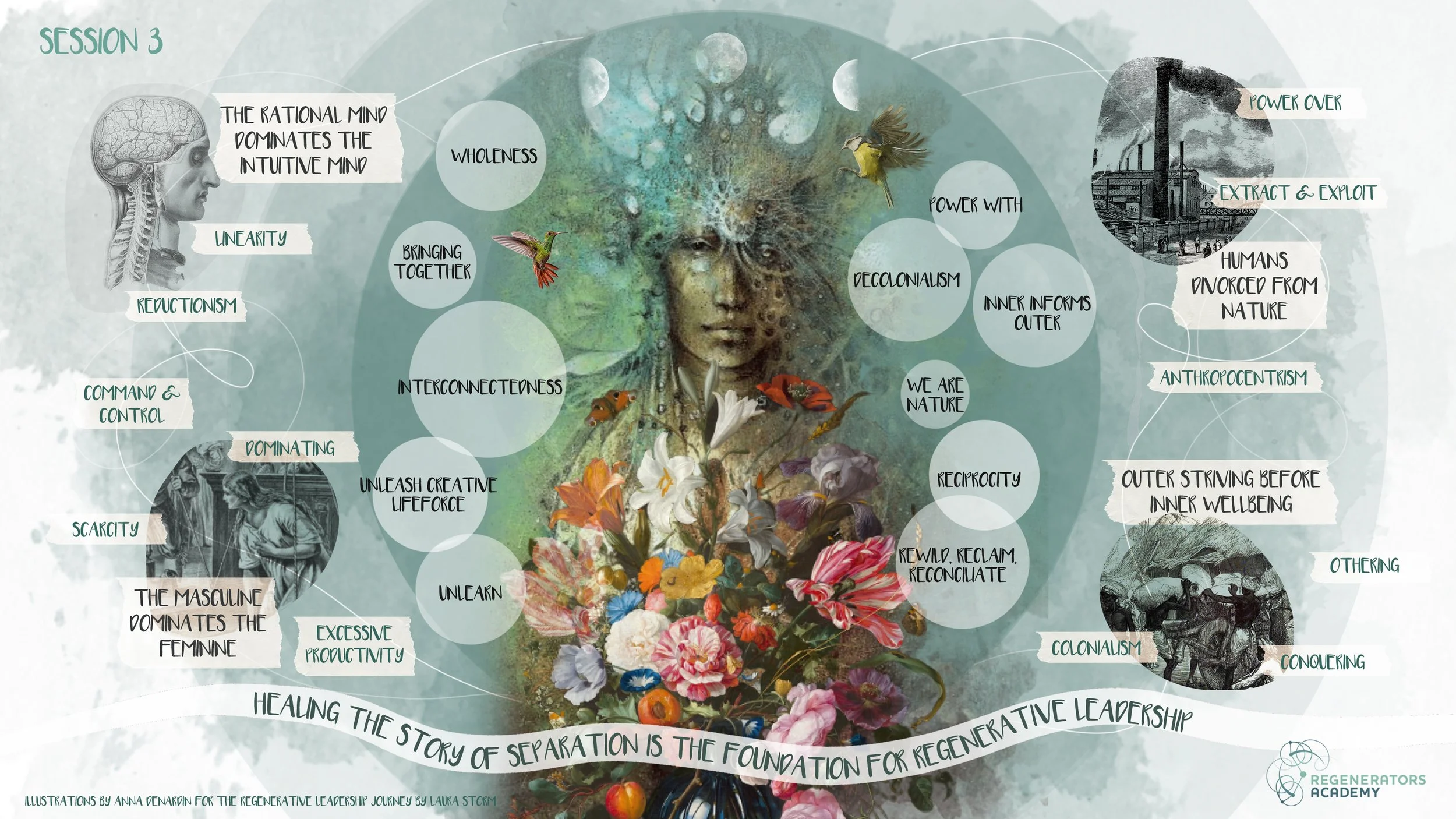
Illustration about the Story of Separation, as shared in the learning experiences by Regenerators. Artwork by Anna Denardin.
Neil and I had a chat to sense into it together. We spoke to Chuka Okeke, Emmanuel's relative in Canada, to understand how his last trip to Oko had been. We had conversations with our life partners to weave their thoughts and feelings into the decision process. We reviewed the risk assessment table and information that Andrea Gamson, also from the Regenerators community, prepared for all of us. I reached out to my friend Raquel Priego, co-founder of the regenerative tourism agency Trip To Help with operations in Africa, for advice from someone who regularly travels to the continent and understands some of its complexities (at least better than me).
We could gather all the information available, request second and third opinions on security, ponder on this decision for weeks… and still it would come down to the fact that saying yes to travelling to Nigeria would never make sense for the minds of the people who have a choice.
In my case, it was clear that it was going to be up to my intuition. And she already had said yes a while ago. My mind still hadn't caught up, but my body was already on board and going through the motions of this gathering in West Africa. The trip had started a long time ago. I just had to book the flights for my mind to realise it.
After getting six plane tickets each, one yellow fever shot, two letters of invitation, and a visa application process that required more paperwork than some of the German bureaucratic processes I regularly deal with, Neil and I were ready for flying into Nigeria on April 6, 2026.
When we finally arrived in Oko, the first thing Emmanuel wanted us to understand was the land itself.
The erosion inside, is the erosion outside
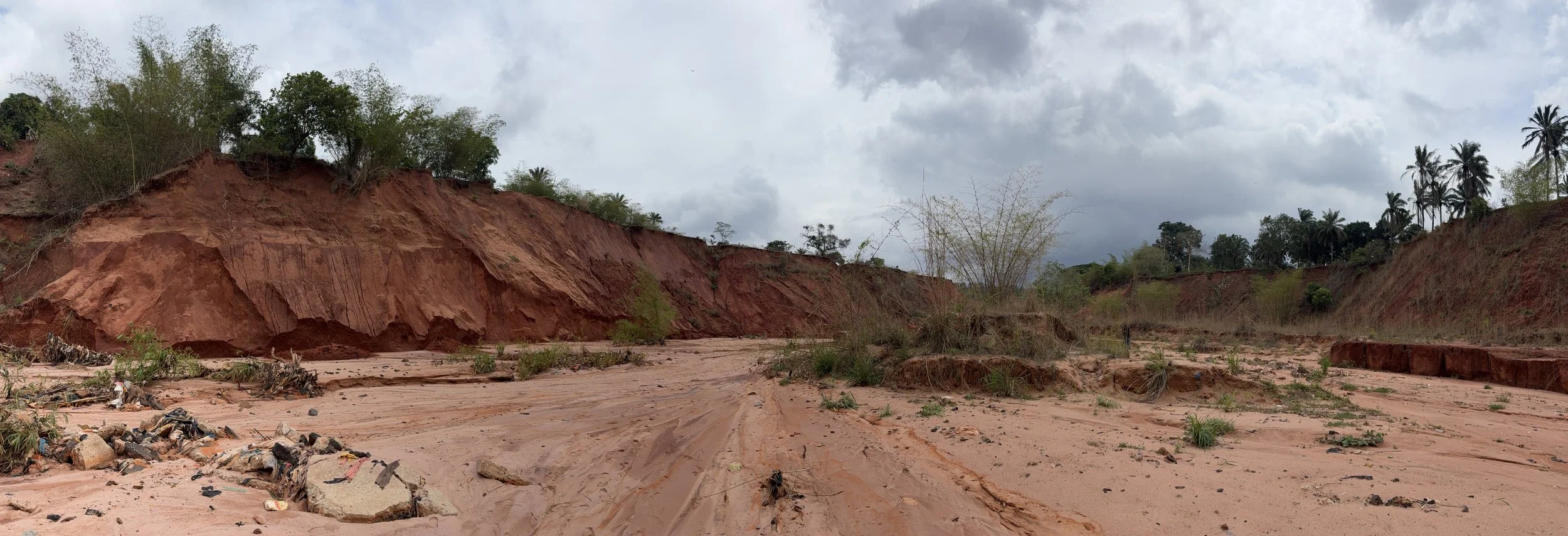
Anambra State, one of the heartland states of Igboland and where Oko is located, has over 1,000 active gully erosion sites, threatening 70% of its landmass and affecting 160 of the state's 179 communities. This ecological emergency, considered the worst erosion situation in Africa, is an ongoing existential threat to the peoples, beings, and lands that face constant risk of landslides. During the rainy season, houses, plantations, and lives are lost to the ground giving way beneath them. The challenge is so massive that the government doesn't have the resources to efficiently face it and, as the years pass and the ecological reality worsens, local communities grow in despair and fear.
Akaama Foundation was born out of this reality. In Oko, Orumba North, one of the areas where the erosion is most active. Beyond the environmental and engineering interventions required, Akaama Foundation offers a different approach to face the challenge. A regenerative one.
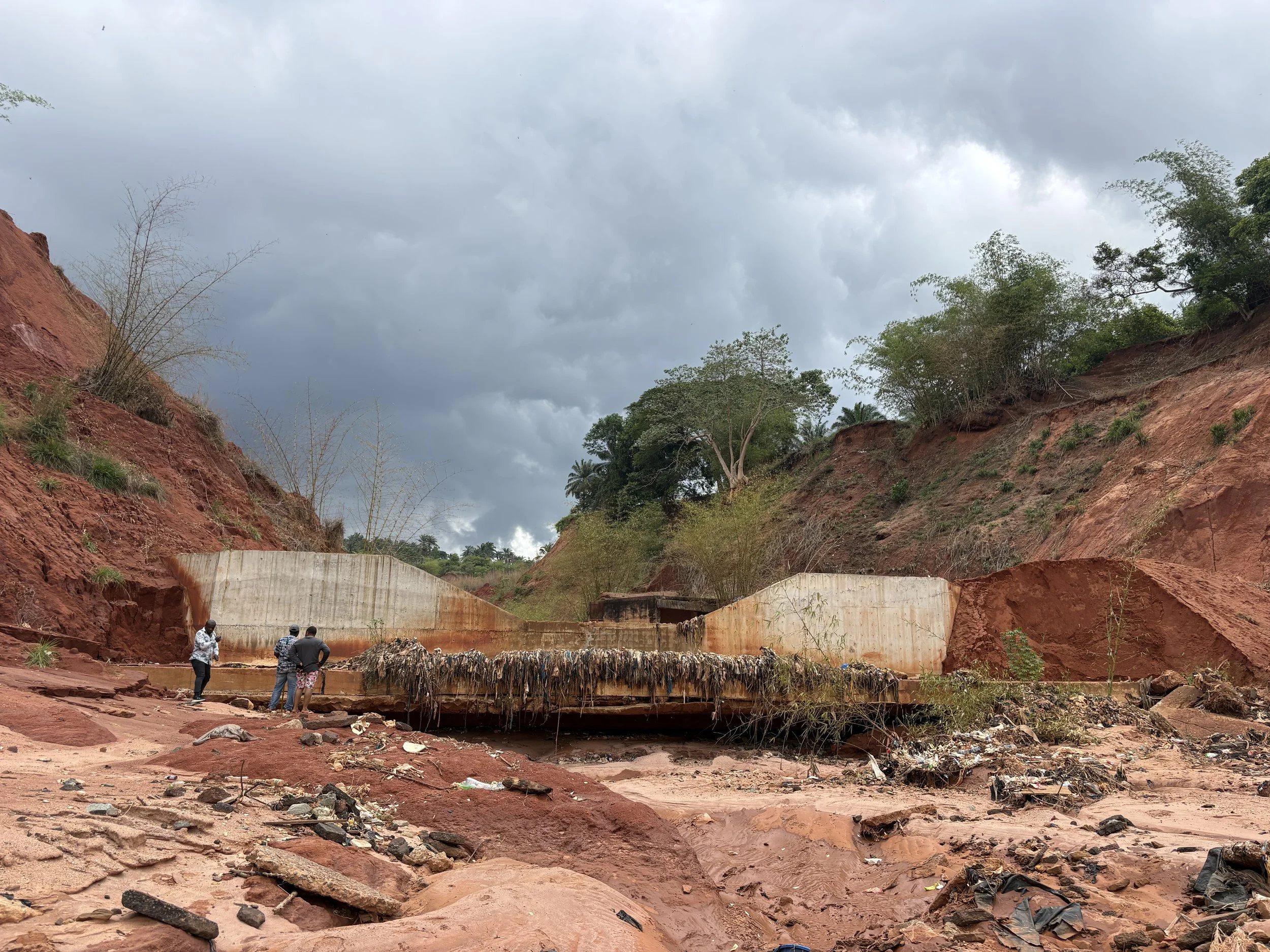
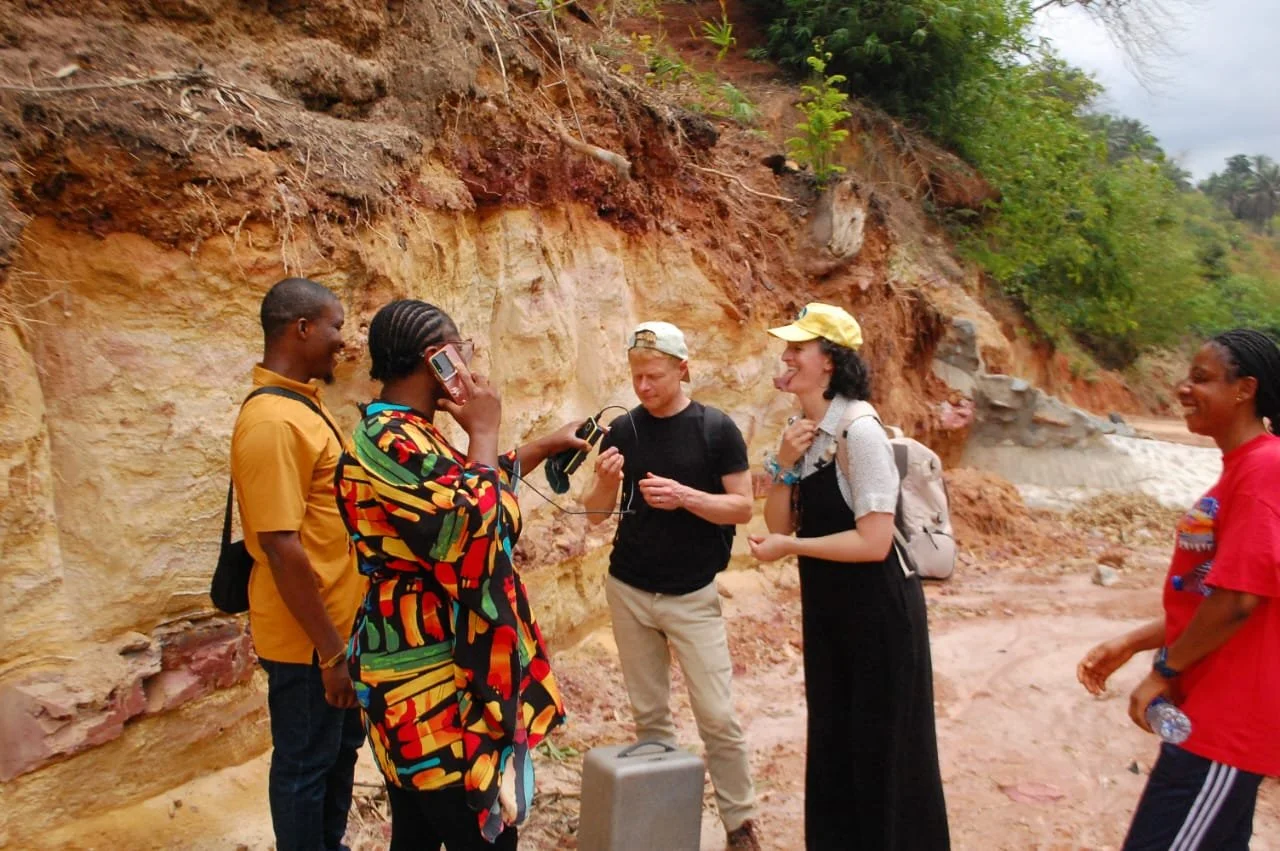
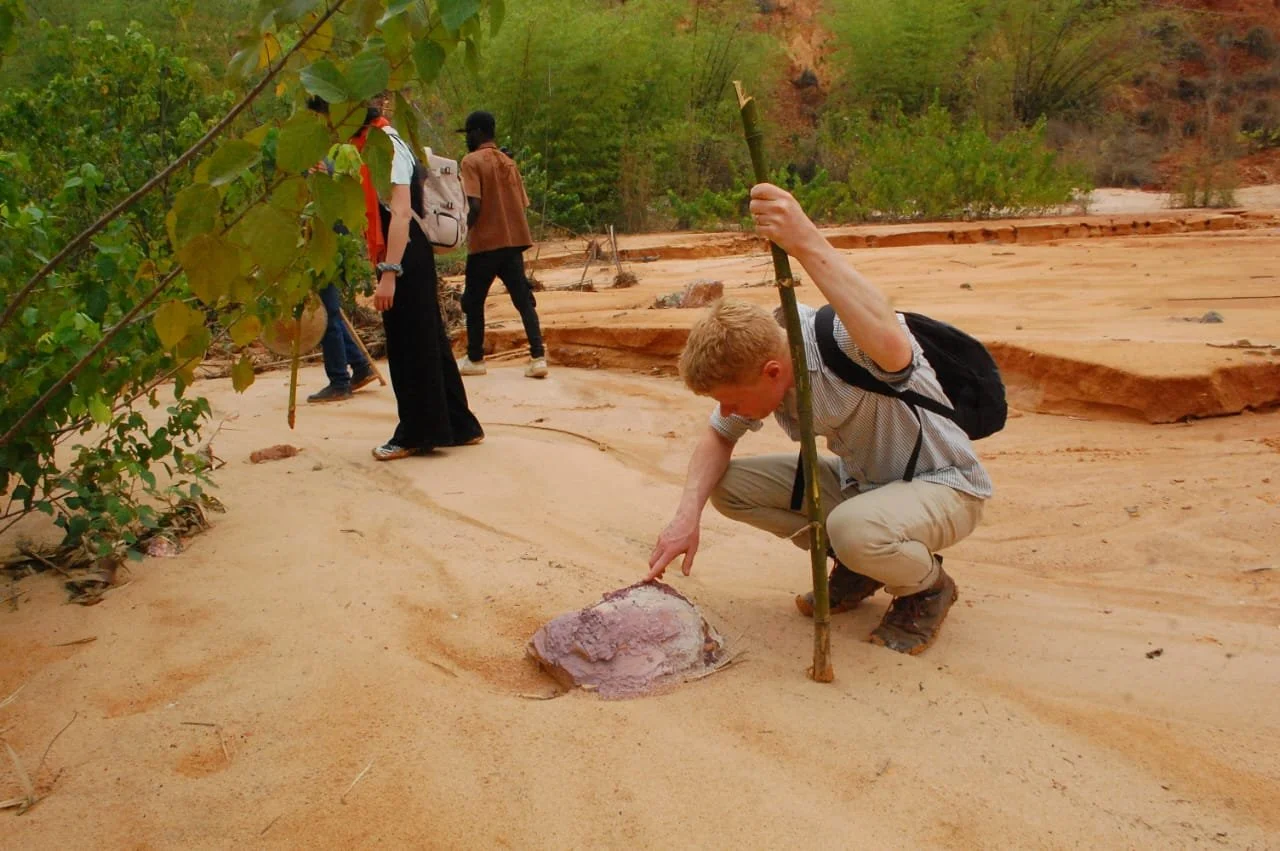
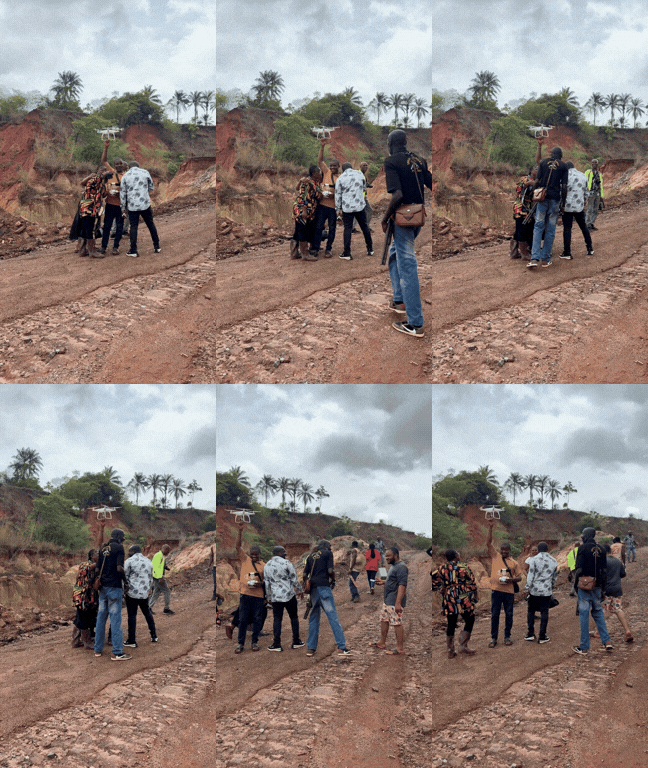
Visiting one of the erosion sites in the Oko region, southeast Nigeria, April 2026.
As its founder Emmanuel says: ‘The erosion we see outside is a reflection of the erosion inside ourselves’. Akaama Foundation sees beyond the terrible consequences of the active gullies in the lands of Anambra State and asks ‘why?’ many times, each question going deeper and piercing through layers of meaning, time, generations, stories, and beliefs until reaching the very roots of this ecological emergency.
Akaama Foundation understands that erosion is a consequence of separation:
Of all the peoples who share their lives in the affected region and struggle to come together to hold their common wounds.
Of generations of unfulfilled promises from the government, leaving people caught between despair and the waiting for a savior that never comes.
Of humans who perpetuate top-down hierarchies with the more-than-human world and see themselves as masters of nature instead of co-stewards within it.
Of religious and spiritual beliefs that push Indigenous wisdom keepers to the margins, leaving communities unrooted from the wisdom of their ancestral lands.
From what I heard and saw, the erosion crisis is in the mouths, thoughts and everyday lives of everyone there. And yet few people pull at the thread to find what lies at the heart of it. Let alone come together to act on it.
This is what Akaama Foundation strives for: awareness, education, action by the communities for the communities. Embracing the differences among the rich diversity of all the peoples who belong to this place, opening up to see below the surface level of causes, holding together the pain of their land, and rolling up their sleeves for activating change that ripples beyond themselves.
Holding this mission in Nigeria adds layers of complexity to an already demanding task that is hard to fully grasp from the outside. I could imagine that the task was big, but couldn’t start to comprehend what it really meant until I was there (not that a short visit gives anyone a full understanding). Emmanuel told us that he had organized meetings with key community figures of Oko like Nwafor Sunday (President-General of Oko’s People Union), Igwe Lazarus Ekwueme IV, Nnanyelugo Ogbonnaya Nwovuegbe, Eze Ijikala II, Ozioko Igwe Oko (traditional king of Oko), Indigenous wisdom keepers and many others who were also invited, like Youth Leaders and Women Wing representatives.
At this point, Neil and I started to understand that our presence in Oko could help move the needle.
You are welcome
By far, this is the sentence Neil and I heard the most in all the interactions we had. We received “You are welcome” throughout our days from almost everybody we crossed paths with, usually accompanied by a huge smile. We were indeed welcome.
If those travelling to Nigeria from the North were doing mental acrobatics in the months prior to the trip, Emmanuel, who held the role of main host, did mental, political, and logistical acrobatics. Conversations with the Akaama Foundation members, community leaders, political representatives, Indigenous people, security teams, filmmaker, hotel managers and many others who made this trip possible were necessary before the guests would set foot in Nigeria.
Emmanuel wasn’t just laying the groundwork for a smooth and safe experience for everybody, but he also understood the impact that receiving these visitors would have for the advancement of Akaama Foundation’s mission. He understood the stakes, and so did we. Neil and I followed his lead in alignment with the intention of this gathering and to fully support the work Emmanuel and the team are doing.
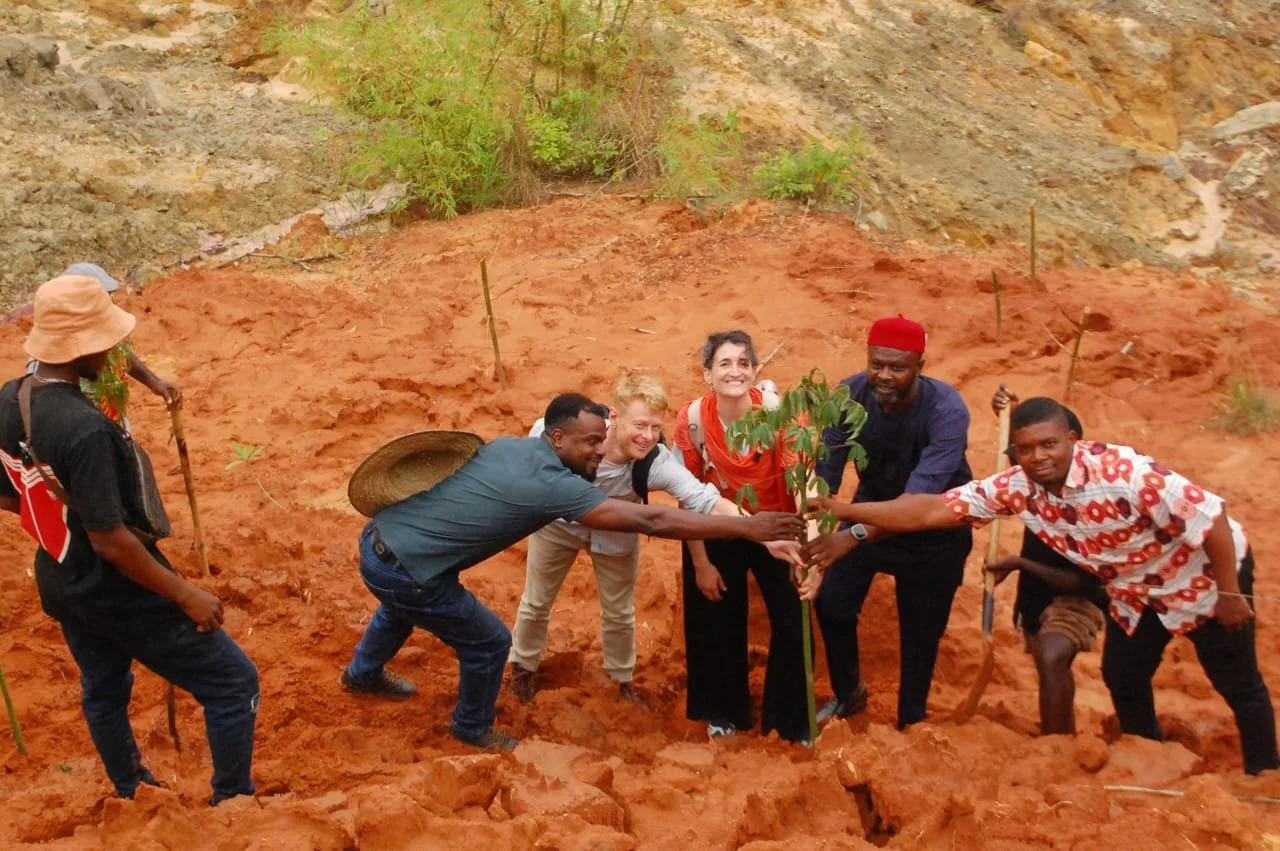
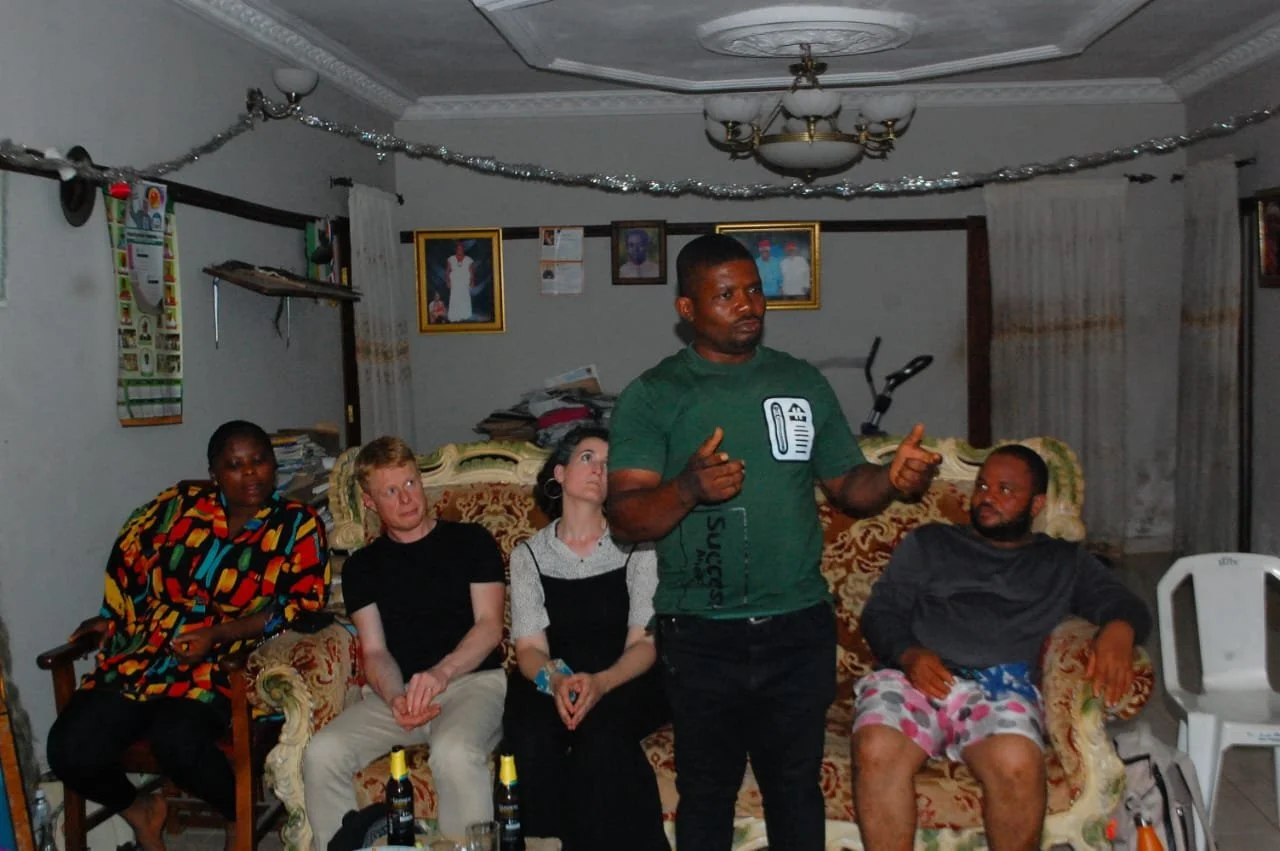
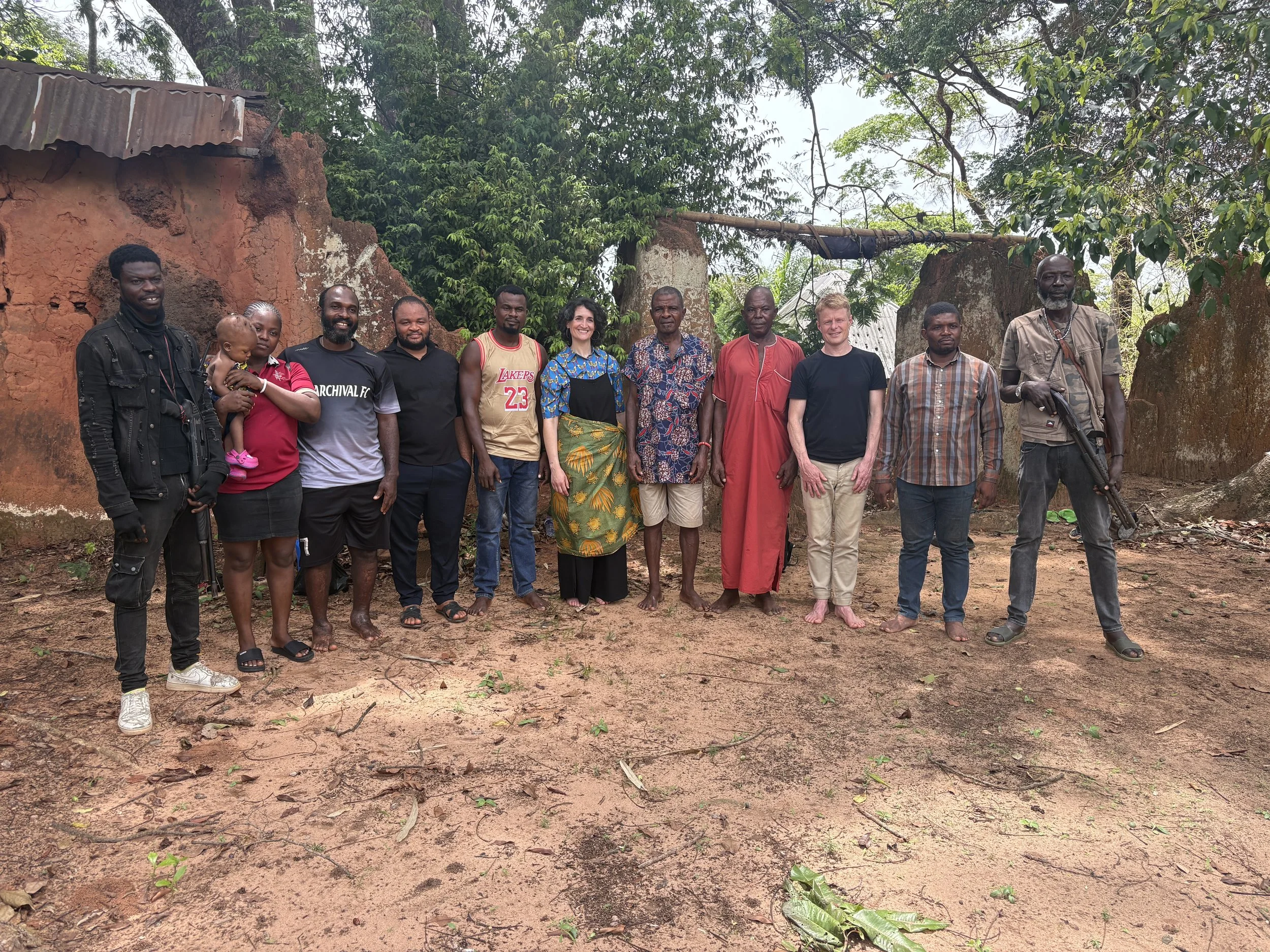
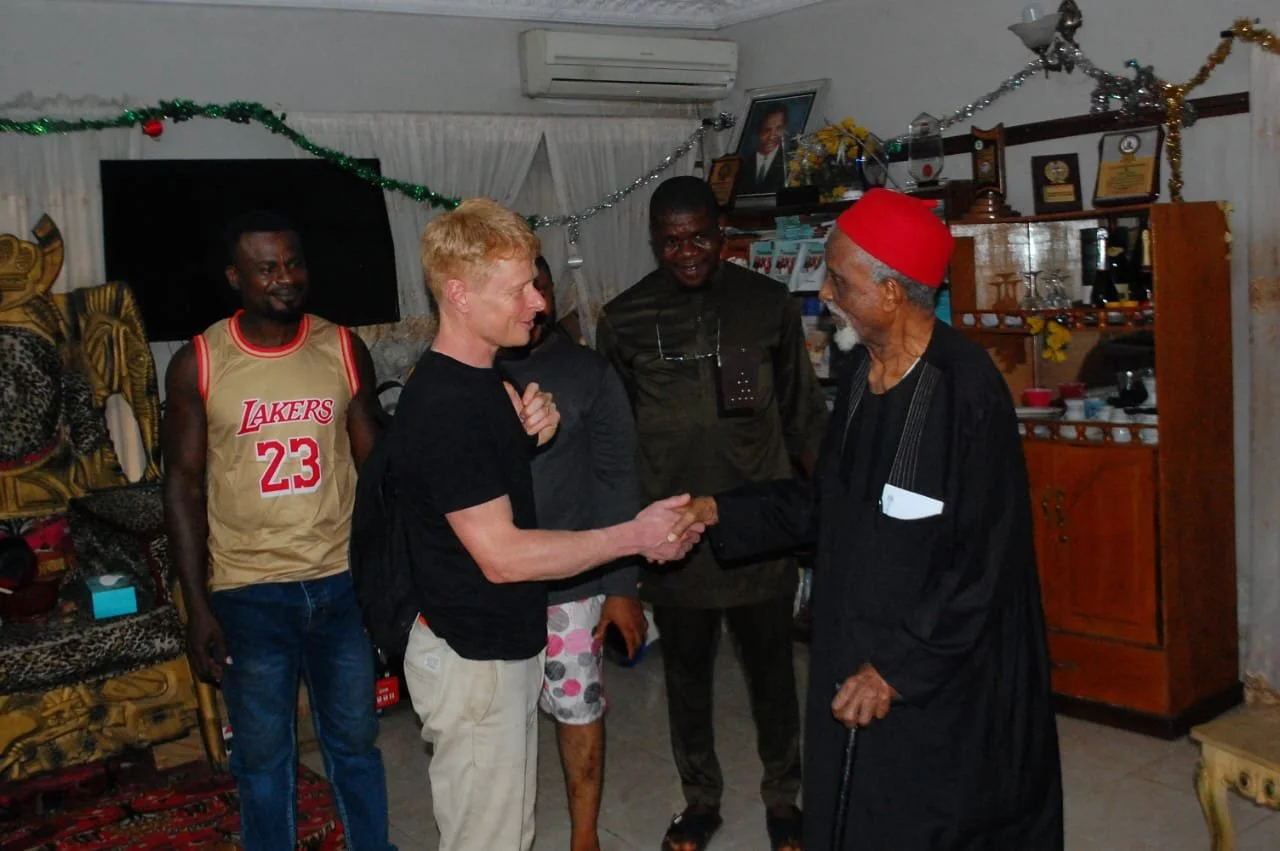
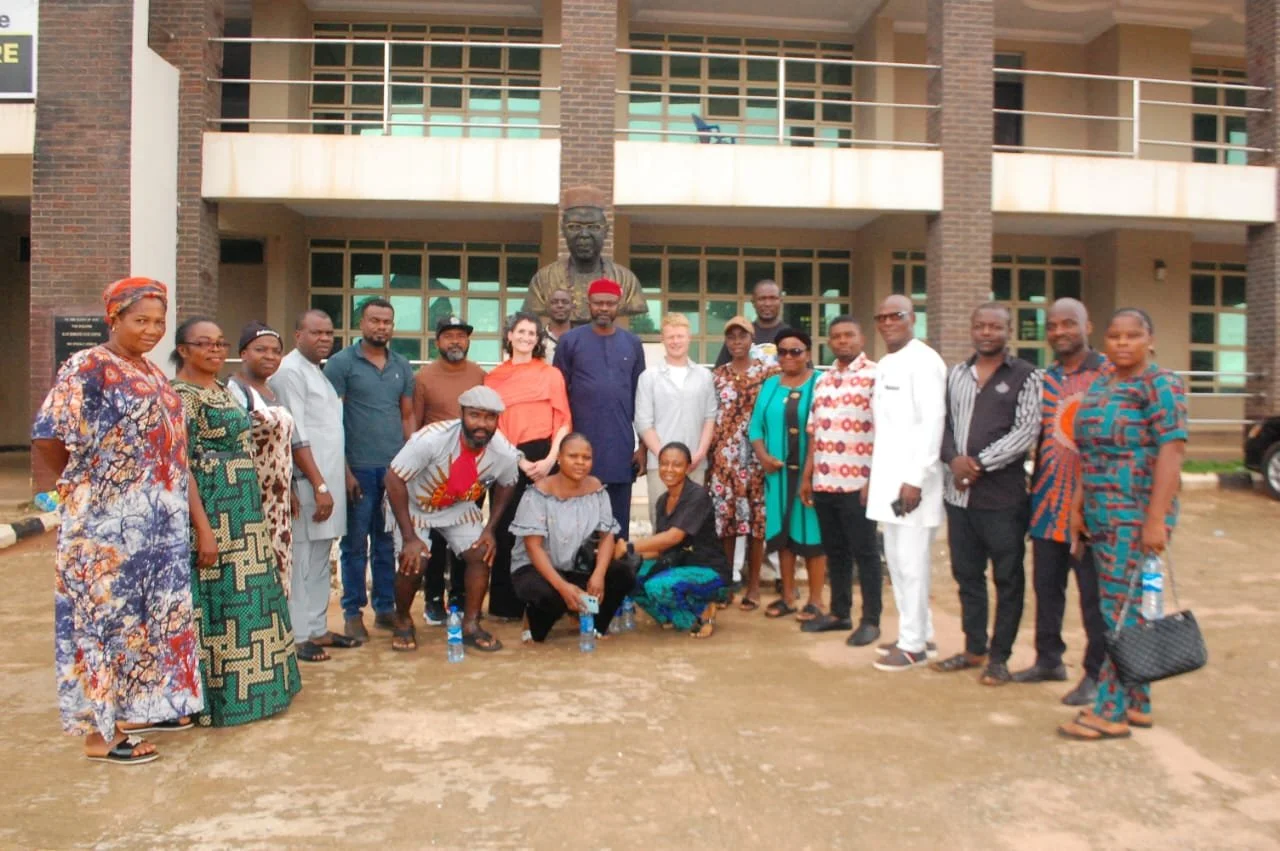
If Nigeria is not a top tourist destination, Oko Town is even less so. Foreigners and especially an Onyeọcha (white person in Igbo language) don't simply appear on the streets of Oko. And white people escorted 24/7 by two security guards as we were is extra attention drawing. “Who are these people? What are they doing here? What did they come for? Why are they meeting with the PG (President-General) and the Igwe?” were questions that Oko residents were going to ask. And this would automatically bring attention to the Akaama Foundation, its work, its mission. A grassroots initiative in the heart of Anambra State had brought two Europeans all the way down there to spend a week visiting the erosion sites and meeting with local leaders. “Emmanuel, where did you find these two?” was also one of the questions.
Nwafor, Uchenna, Phina, Ifeatuchukwu, Nnaemeka, Sussan, Okechukwu, Ngozi, Okwuchukwu, Emmanuel
I could keep on writing about Akaama Foundation, the conversations we had while Neil and I were in Oko, the sharings and reflections, the walks in the erosion site, the blessings we received from political and community leaders… yes, the foundation moved forward in meaningful ways during our visit and this wouldn’t have been possible without the commitment of its members, whose names are above, to make a difference.
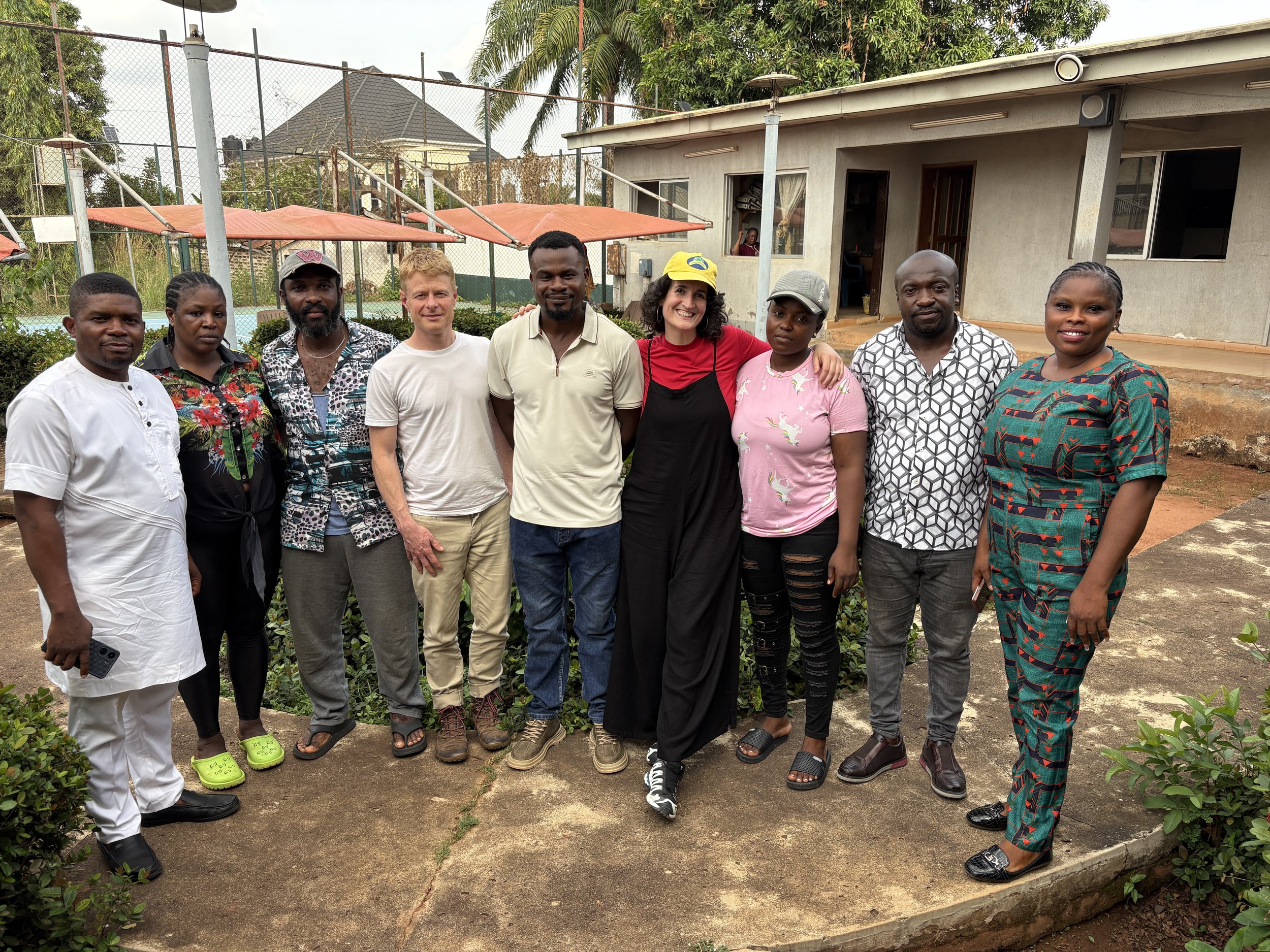
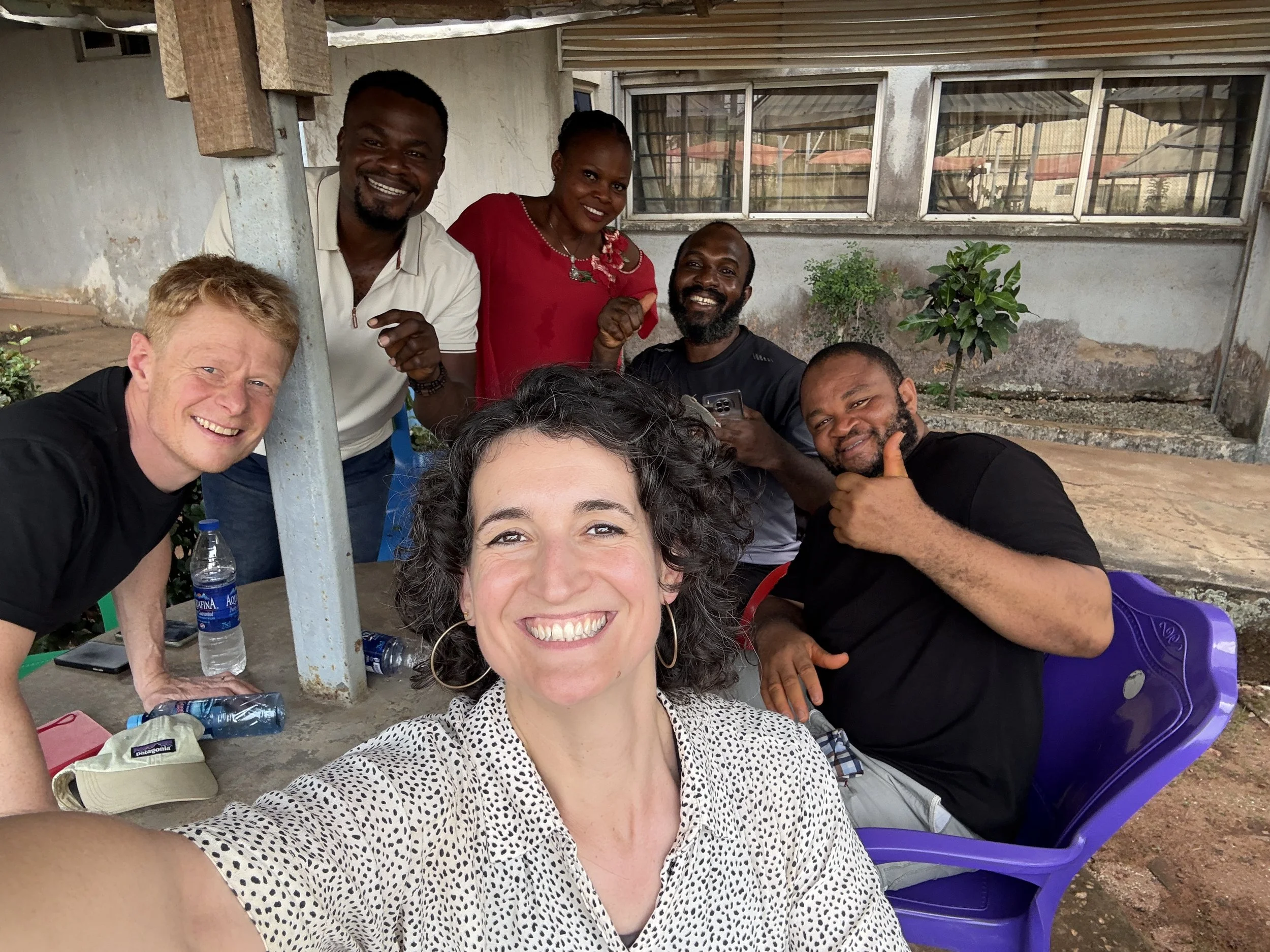
It was a common image to see Emmanuel with two phones attending calls all day while he was also explaining to us about akpu, one of the sacred trees in Igboland, or leaving his swallow food aside to speak to somebody and organize the next point on the agenda. Each of the foundation members has their families, businesses, and responsibilities. And they all move things around and travel to be present in meetings, write memos, and do whatever is necessary to keep tending to the mission of Akaama Foundation. They belong to Igboland, to Oko, and feel the pain and sorrow of the eroded land in their bodies.
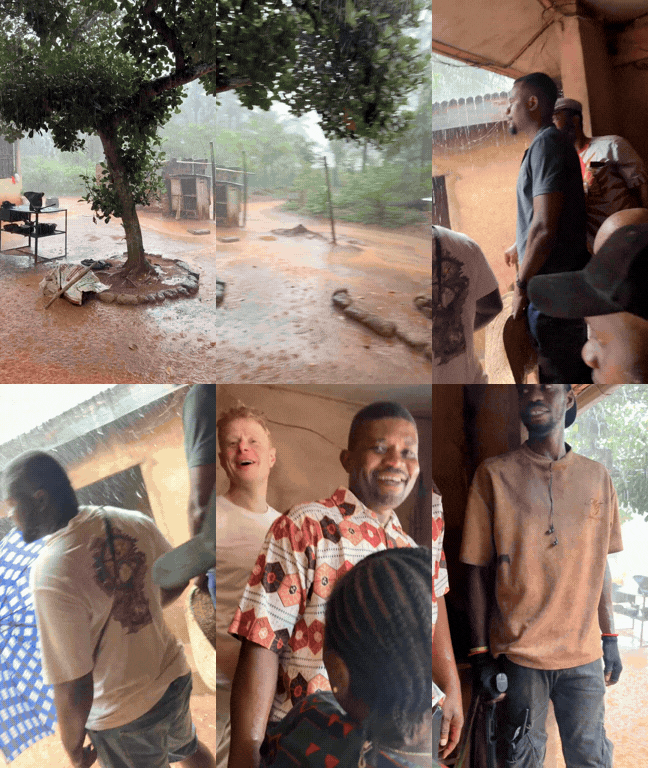
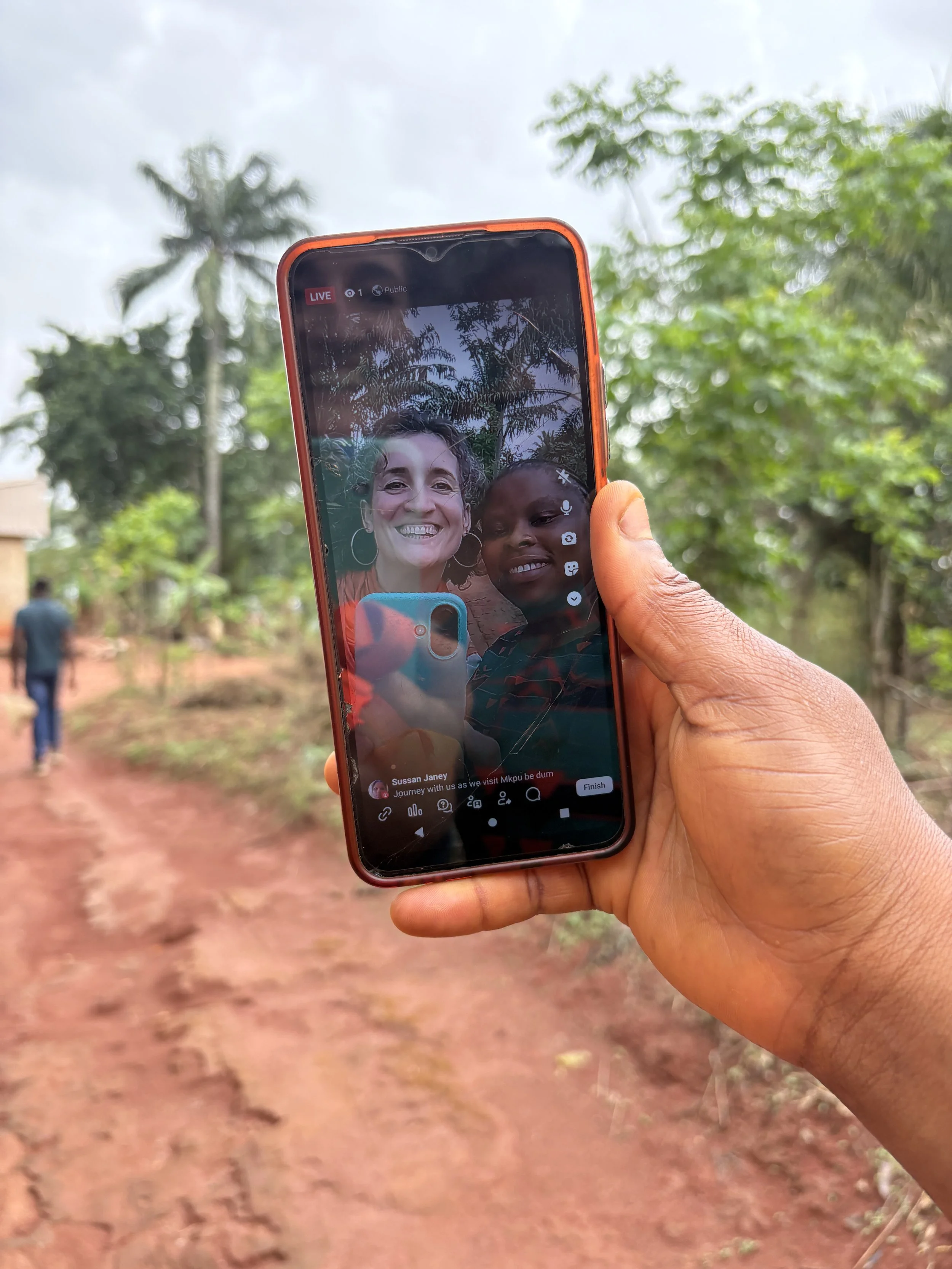
“Life in Nigeria is not easy”, I heard from them more than once. With the heaviness of that statement and the background of threatening erosion sites all around,I could appreciate much more the moments of joy that emerged everyday. The work wouldn't have been possible without the sprinting and laughing when the rain caught us, Emmanuel singing in the car, Sussan’s selfies and high fives, Nwafor’s stories of his childhood, cooking scrambled eggs at Nnaemeka’s, standing below an active drone to fan ourselves, the warm “good morning” of our security team when we were leaving the hotel, the loving smiles, hugs, and eyes.
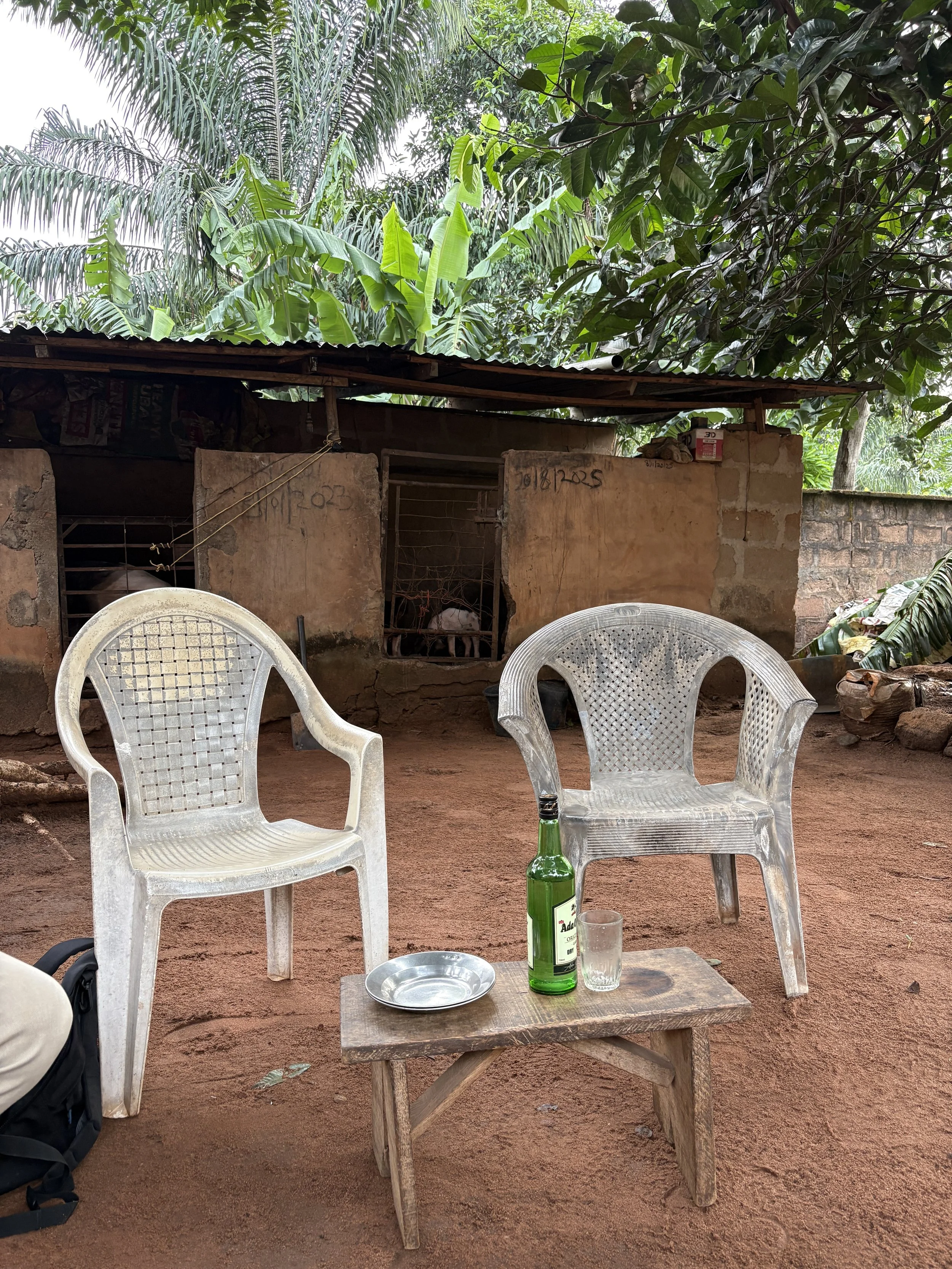
And it wouldn't have been possible either without holding the sacred in deep presence: breaking and chewing kola nut in circle, spilling gin on the soil for the ancestors, the silence sitting around the fire in the forest, feeling the sandy soil of the gullies crumble between our fingers, touching the ground to the sound of isee, standing together to pray, walking barefoot in the ancestral sacred land.
I mentioned before that the peoples and lands of Nigeria and Africa cracked my heart open. And pieces of it stayed with them as well.
The experience that keeps on giving
I’m writing these lines a few weeks after my return to Europe, staying at the moment in the north coast of Barcelona. Here, I’ve been able to start unwrapping some of the gifts I brought with me from Oko, Nigeria, and Africa. Not magnets to put on the fridge, but paradoxes and complexities to keep on holding.
I present them as they are: wicked questions. They will likely resonate most with white regenerative practitioners, so I invite you to explore them as feels right. And carry them with you if you feel a contraction in your body when you read them. If so, they are onto something.
How do we speak about regeneration without flattening the depths these words carry in contexts where they are not metaphors but lived survival?
Regeneration is one of those trendy buzzwords nowadays. A word I stumbled upon just 3.5 years ago. From not understanding what it meant to now being a co-steward in an organisation called Regenerators, the glossary of living systems is well integrated in my body and mind. So much that sometimes I need to water it down depending who I’m speaking to, if I don’t want to lose them in the conversation. This wasn’t the case speaking with some of the people I met in Nigeria. I knew that with Emmanuel and Adeola, as fellow Regenerators alumni, we'd have that shared language. And I was glad to see others in Oko bringing their own words and expressions to the conversation, arriving at similar regenerative lenses.
What surprised me the most was sensing new depths in the same words we were using. For example, I could feel that “ancestor” had more layers of significance when Emmanuel would use it in a sentence in comparison to when I would use the same word. “Ancestor” was arriving to me as elder, land, tree, death, violence, respect, pray, compassion, wisdom, guardian, responsibility... All in eight letters. With painful poetry, I could see the exposed layers of meaning of one word they would use as I could see the stratified layers of soil in the sides of the erosion site.
Words take different shapes in relation to the context where they are expressed, and seeing words regenerative practitioners use everyday in the context of Nigeria and Nigerian voices turned them into complex nuanced entities of their own. After a few days, I struggled to use words that suddenly felt shallow in my mouth, as if I wasn’t deserving to speak about that if I couldn’t honor the depth I had seen it could reach. I wasn’t even able to open LinkedIn and see certain words and topics on my feed without feeling both frustration and shame. “How am I going to speak about regeneration after this?”, I asked my partner one evening after arriving at the hotel.
How do we show up for decolonial work without reproducing the colonial dynamics we intend to dismantle, even as they keep arising all around us?
While in Oko, the needle was moving just because we were there. Ripples started spreading even without us having to open our mouths or say anything clever. When the floor was given to us I kept wondering: “Is it because I’m seen as a white person who supports the mission of the Akaama Foundation, who has knowledge and experience in community building and tending to regenerative paradigms, and has travelled here to learn more about the situation, offer perspectives, and reflect together? Or is it because I’m seen as a white person? Period”.
Colonial paranoia at its best. That sentence we kept receiving, “You are welcome”, grounded me in trust at times, and triggered shame and heaviness at others. As much as I felt lovingly held as a guest by the people in Oko, I could not notice that the color of my skin and the place where I was coming from was opening doors, providing special treatment, and giving a different weight to my words. Traveling more than 5,000 km south holding decolonial intentions to find myself fully embodying the very privileges I question was a massive paradox for me. Something I still feel uncomfortable with, something I accept that will continue being uncomfortable.
For any white person reading this: Regenerative work doesn't exempt you from the systems and dynamics you're trying to change. Tokenization, white supremacy, entitlement are colonial patterns that pervade so deeply, especially in South-North relationships, that they may be noticeable just to those willing to look below the surface. And if you're even slightly aware, I'd suggest assessing your white fragility and training in the decolonial gym so that you keep your footing when these patterns hit you in the face. Just like they hit me.
When the North bridges with the South, how do we engage without turning the rawness of other people's realities into fuel for our own growth?
What I saw in Nigeria was full spectrum reality. I first had a glimpse of this while living in Istanbul in the early 2010s, and then traveling in Sri Lanka and India, other parts of the world that keep sending me shockwaves years after. Nigeria has been an earthquake of its own, adding a new layer of volatility that I hadn’t experienced before. Beauty and ugliness, pleasure and pain, groundedness and spirituality have a more real texture the more raw they are, the more you let them reach the edges of themselves. So much so that they sometimes meet each other at the edges.
I love Europe with my full heart (I speak of southern and central Europe, where I have lived most of my life), and I’m aware of how much sterilised it feels sometimes. The aim for balance and stability sands the edges of everyday life, putting corner protectors and drawer locks everywhere. I guess the older you get the more you appreciate this, but my body doesn’t seem to subscribe to this way of aging and keeps craving the extremes.
I say this with full awareness of the privilege I have as a European citizen, as somebody who by birthright can live in a harmonious and stable place, and who chooses to dip her toe in alternative realities (that usually can be found in the cultures colonised by her ancestors) to indulge her soul desires for entropy. I never liked vanilla and I don’t think life can be fully tasted without sugar rushes and bitterness kicking your tastebuds. At the same time, life tends to syntropy: toward the kind of order and balance that emerges not from avoiding chaos but from moving through it.
These paradoxes Nigeria gifted me don’t expect answers or solutions. Nor do I expect you, dear reader who made it this far, to come up with an answer that can pull me out of my predicaments.
We can let them be. We can continue holding them. Not with passive inaction, but with humble steady steps forward into the complexities and depths the modern world presents us with.
If this piece has left you unsettled, sitting with questions that have no clean resolution, good. That discomfort is not a problem to be solved, it’s the beginning of something. Lean into it. Let it stay a little longer than is comfortable. That is where the work lives.
Just like my siblings in Oko do everyday.
If you want to know more about Emmanuel and Akaama Peoples Empowerment Foundation, I recommend the piece written by Shimrit Janes on the Regenerators blog “Planting Seeds of Regeneration For The Lands And Peoples Of Oko Community”. Also the episode “The return of the African Oak in West Nigeria - with Emmanuel Izuegbunam” on the podcast “When Nature Talks” by Miriam Dahmane.
Akaama Peoples Empowerment Foundation is looking for partners across several areas: designing and running a Regenerative Vocational Academy; tree planting and forest creation to address the food crisis in local communities; training youth in Regenerative Leadership; creating beaver dams and flood control systems; integrating regenerative agriculture into indigenous food cultures; and support with digital presence, websites, and social media. If any of this calls to you, reach out to Emmanuel directly via LinkedIn.
Regenerators’ Business Model is designed to channel funding to custodians of ecosystem regeneration: a percentage of the annual revenue flows directly into regenerative projects with a focus on land restoration and empowering Indigenous voices. Since 2022, an average of €12,000 annually has flowed into different grassroots organisations, including Akaama Peoples Empowerment Foundation. Learn more about this here.